- Author
- Nasser Ibn Dawood
- Book number
- 71 / 139
- Language
- English
- Pages
- ≈ 4
- Words
- 911
- Reading time
- ≈ 0.1 h
- Category
- Quranic Studies
- Licence
- CC BY-SA 4.0
Page count is estimated from the text size (911 words); the library index records no print page count for this title.
Text extracted from the author-supplied Word edition; consult the original source.
Opening of the book
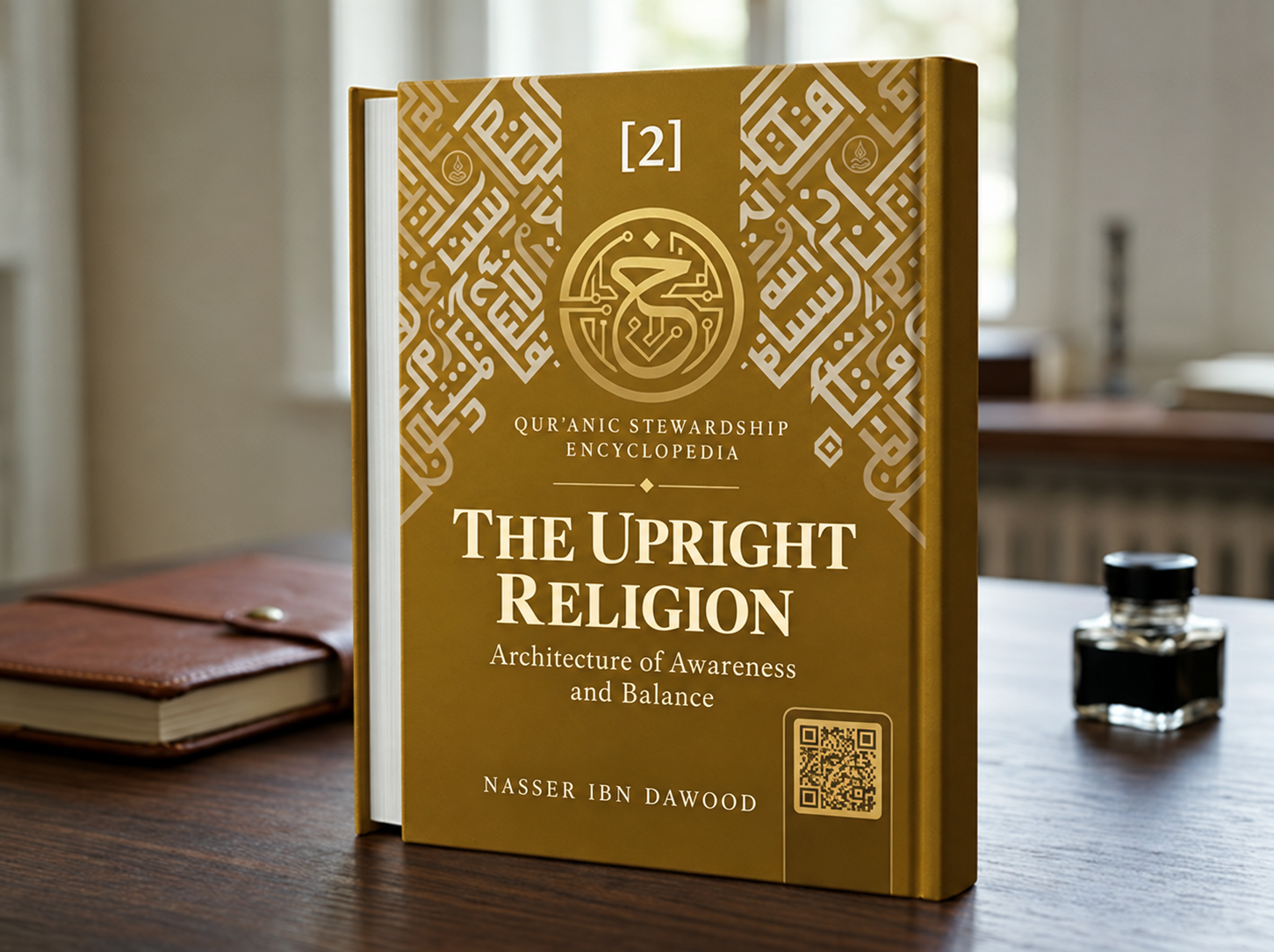
This volume begins with a question: how can a person or community receive guidance yet lose the meanings that should govern understanding and action? The author argues that religious language has often been narrowed to identity, ritual, or inherited formulas. To address this, the book studies concepts through their roots, contexts, and relations, while distinguishing the Qur’anic text from interpretive conclusions and proposed models.
The author reads “religion” as a broad ordering of human life under governing principles, and “upright/sustaining” as a quality associated with maintaining balance and preventing structural collapse. The compound expression “the upright religion” is therefore developed as a conceptual framework for a way of life that can preserve orientation across changing circumstances. This is the author’s linguistic and systems-based thesis; it should be read as an argument to assess, not as a universally settled definition.
The book presents language as formative: names and concepts shape what people notice, how they classify experience, and which choices seem possible. In its reading of the Adam narrative, the teaching of the names becomes a foundation for human knowledge and responsibility. The author’s model connects naming, perception, judgment, and action. It is a proposed explanatory framework, not a direct Qur’anic statement about a modern theory of cognition.
Topics
- Upright religion
- Awareness
- Balance
- Architecture of religion
Download the book
Formats: TXT · DOCX · PDF
Read the PDF on this website
Preparing the reader…