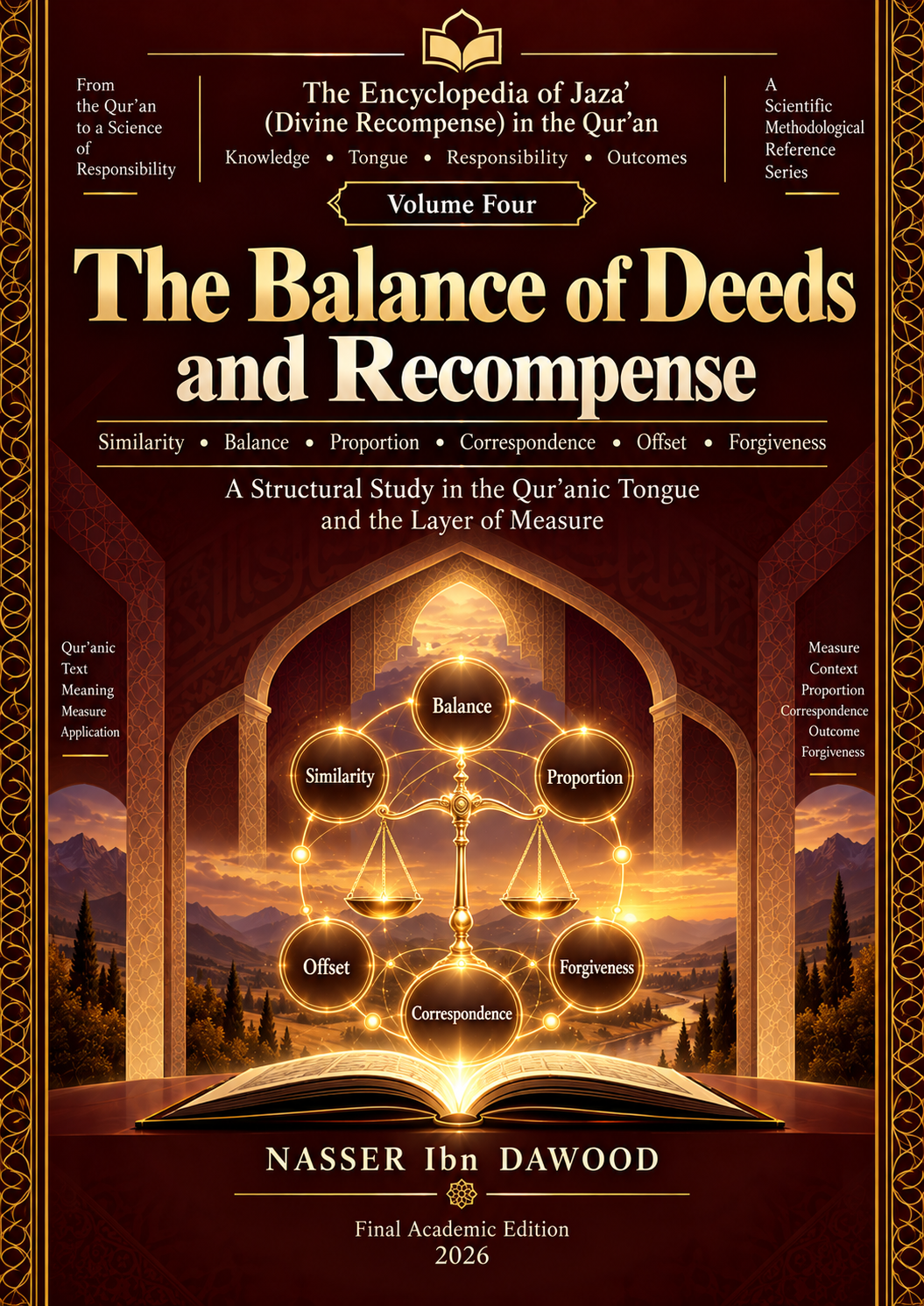
- Author
- Nasser Ibn Dawood
- Book number
- 90 / 139
- Language
- English
- Pages
- ≈ 21
- Words
- 5,251
- Reading time
- ≈ 0.5 h
- Category
- Quranic Studies
- Licence
- CC BY-SA 4.0
Page count is estimated from the text size (5,251 words); the library index records no print page count for this title.
Text extracted from the author-supplied Word edition; consult the original source.
Opening of the book
The purpose of this publication policy is not merely distribution. It is methodological: a claim that cannot be revisited, tested, compared, and criticized remains weaker than a claim whose evidence and procedure are visible to the reader.
Qur’anic terms are therefore retained whenever translation alone would flatten the analysis. A term such as Mīzān (ميزان) is rendered with an English equivalent—measure, balance, or calibration—while the Arabic form remains visible. The same principle applies to ʿAdl (عدل), Qisṭ (قسط), Qiṣāṣ (قصاص), ʿAfw (عفو), Ṣafḥ (صفح), Ghufrān (غفران), Faḍl (فضل), Ziyāda (زيادة), and Muḍāʿafa (مضاعفة).
The edition also preserves the author’s distinction between a useful model and a law. A repeated relation may justify an analytical model without authorizing a universal causal rule. A lexical nucleus may close within a declared corpus while another layer remains open. The condensed form must not strengthen a claim merely because it has fewer pages.
Topics
- Recompense engineering
- Measure of recompense
- Balance
Excerpt
The manuscript also notices a possible bridge to al-Zumar 39:10, where patient endurance is associated with an unbounded description of reward. Yet it refuses to turn this juxtaposition into a law connecting relinquished response to unlimited positive grant. The bridge is a research question, not a completed causal rule.
By Nasser Ibn Dawood — The Engineering of Recompense in the Qur’an — Volume IV: The Measure of RecompenseDownload the book
Formats: TXT · DOCX · PDF
Read the PDF on this website
Preparing the reader…