- Author
- Nasser Ibn Dawood
- Book number
- 91 / 139
- Language
- English
- Pages
- ≈ 24
- Words
- 5,966
- Reading time
- ≈ 0.6 h
- Category
- Quranic Studies
- Licence
- CC BY-SA 4.0
Page count is estimated from the text size (5,966 words); the library index records no print page count for this title.
Text extracted from the author-supplied Word edition; consult the original source.
Opening of the book
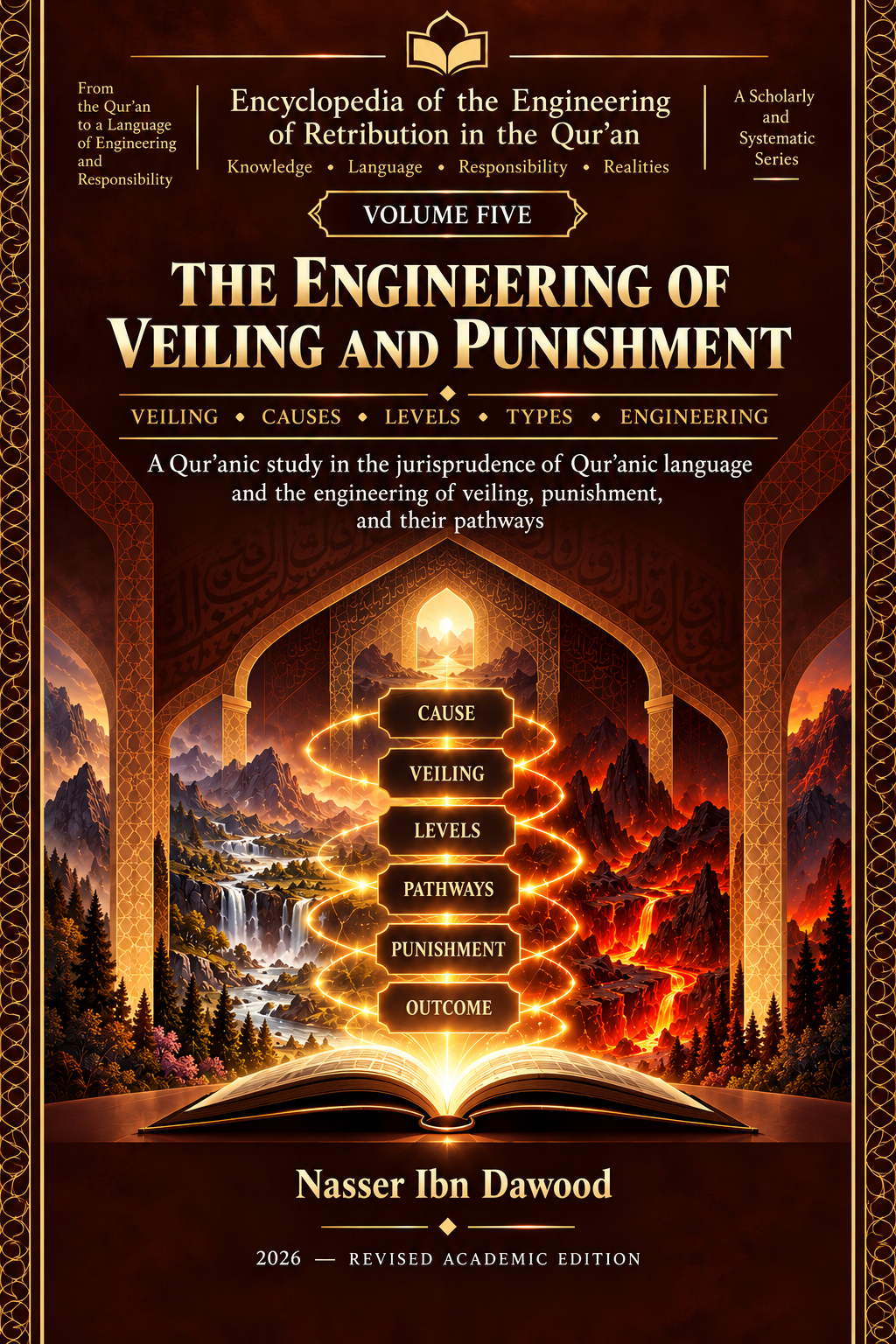
This volume studies a difficult question: what happens in the Qur’anic text when receptivity is obstructed, moral agency is distorted, punitive consequence appears, or a process moves toward a negative outcome?
A conventional treatment could begin by defining words such as “seal,” “veil,” “misguidance,” “punishment,” “taking,” “vengeance,” “respite,” “gradual entrapment,” or “destruction,” and then arranging them in a theological sequence. This book deliberately refuses that shortcut.
Before asking what a term “means,” it asks what the text actually does with the term: How many occurrences are there? In which grammatical forms? Who is the agent? What is the object or target? Which prepositions recur? Which terms appear together? Which do not? Does a recurring pattern survive the strongest counterexample? Does a result belong to the whole root, or only to one branch, one form, or one lexical item?
Topics
- Recompense engineering
- Veiling
- Adhab
- Engineering of veiling
Excerpt
Many occurrences exert a strong semantic pressure toward power, severity, or force. This pattern is real. Yet one verse describes hands with which beings might yabṭishūn, demonstrating that the corpus can use the term in a more direct bodily-instrumental frame without requiring a global “severity” definition.
By Nasser Ibn Dawood — The Engineering of Veiling and ʿAdhāb — Volume VDownload the book
Formats: TXT · DOCX · PDF
Read the PDF on this website
Preparing the reader…