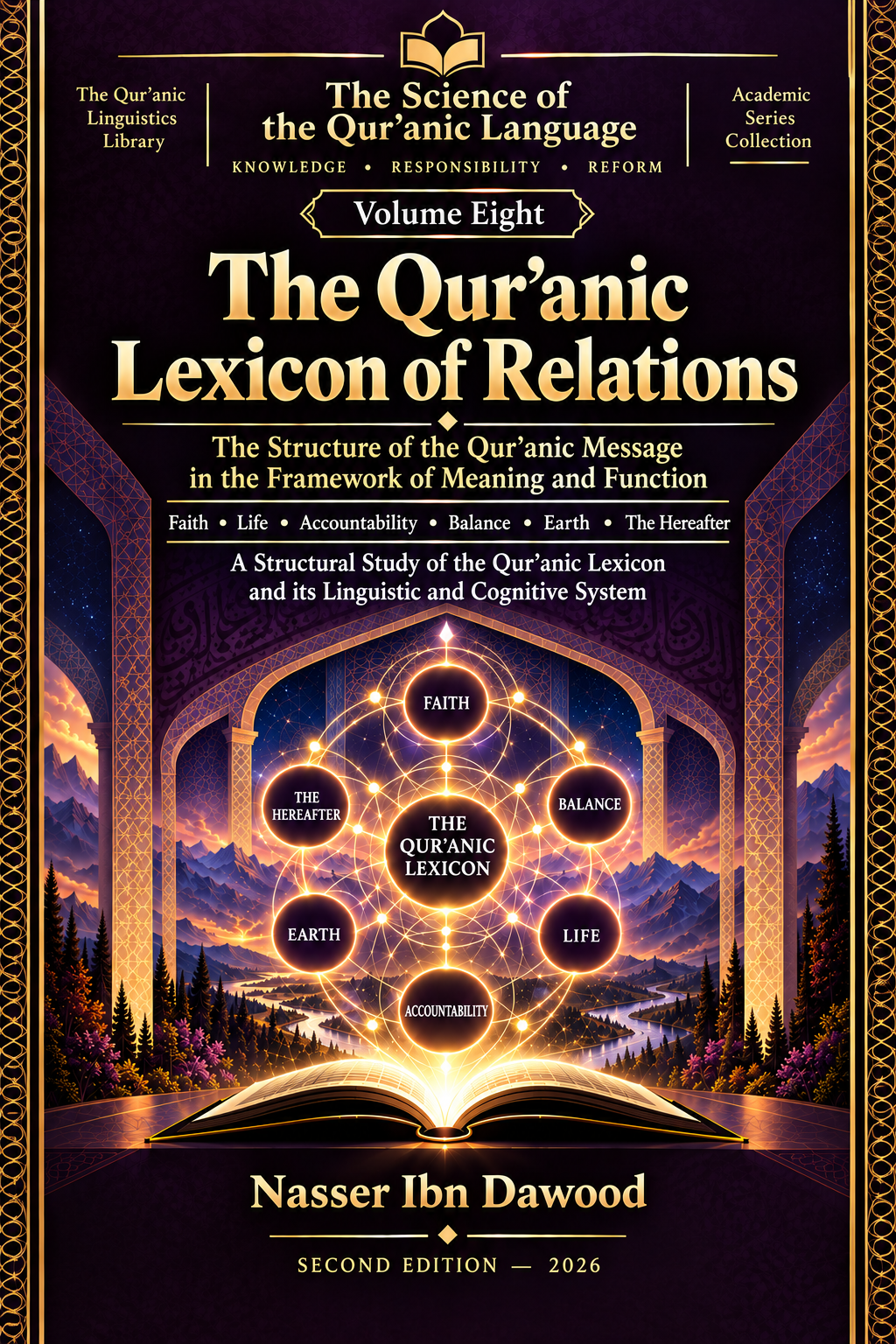
- Author
- Nasser Ibn Dawood
- Book number
- 94 / 139
- Language
- English
- Pages
- ≈ 21
- Words
- 5,372
- Reading time
- ≈ 0.5 h
- Category
- Quranic Studies
- Licence
- CC BY-SA 4.0
Page count is estimated from the text size (5,372 words); the library index records no print page count for this title.
Text extracted from the author-supplied Word edition; consult the original source.
Opening of the book
Volume VIII changes the scale of the inquiry. The preceding work of the series had already examined many fields within the Qur’anic system of recompense: trial, action, responsibility, effect, balance, veiling, punishment, outcome, return, forgiveness, expiation, reform, and related concepts. The new difficulty is no longer simply to ask what a word means. It is to ask how these fields are connected, what kind of connection is actually supported by the text, and how far that connection may legitimately be extended.
This shift is decisive. A reader can identify two elements in the same verse and still know very little about their relation. Co-presence does not tell us whether the link is causal, conditional, contrastive, purposive, recompensive, sequential, representational, or merely contextual. A repeated order of terms can be significant without being a universal chronology. A shared structure can be real without having the same scope. A locally supported relation can remain valid even when its attempted universalization fails.
The volume therefore moves the center of analysis from the node to the edge: from the isolated concept to the disciplined study of the bridge between concepts. The question becomes: what exactly does the textual resource allow us to say about this bridge? The book repeatedly refuses to let the visual simplicity of an arrow hide the complexity of the evidence. An arrow between A and B can conceal assumptions about direction, causality, timing, sufficiency, scale, mediation, and transferability. Each assumption must be tested rather than supplied by the reader.
Topics
- Recompense engineering
- Engineering of relations
- System of recompense
Download the book
Formats: TXT · DOCX · PDF
Read the PDF on this website
Preparing the reader…