- Author
- Nasser Ibn Dawood
- Book number
- 85 / 139
- Language
- English
- Pages
- ≈ 18
- Words
- 4,404
- Reading time
- ≈ 0.4 h
- Category
- Quranic Studies
- Licence
- CC BY-SA 4.0
Page count is estimated from the text size (4,404 words); the library index records no print page count for this title.
Text extracted from the author-supplied Word edition; consult the original source.
Opening of the book
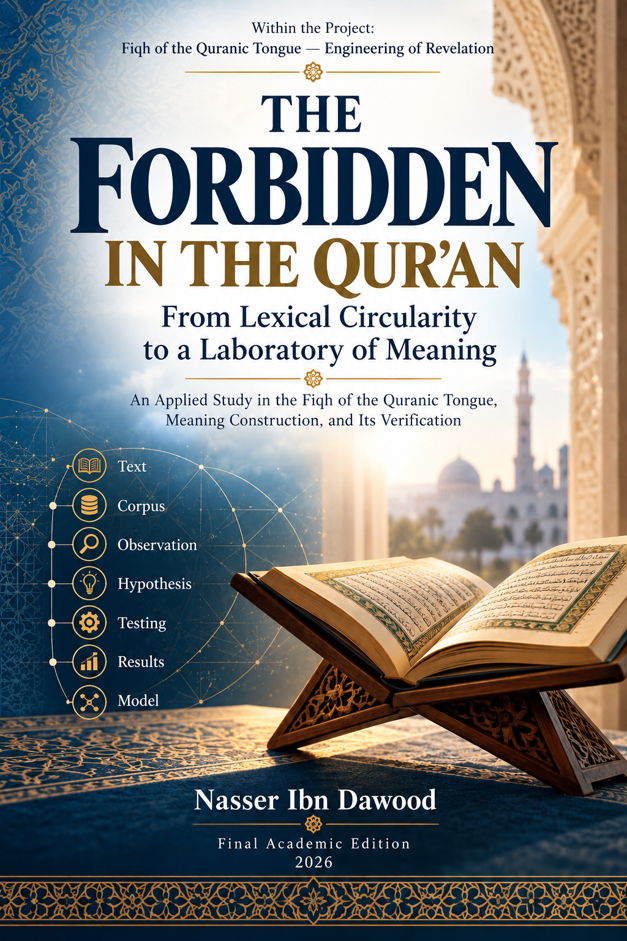
This version preserves the architecture of the argument, the methodological safeguards, the principal test results, and the declared limits of the Arabic edition. It deliberately compresses technical records, repeated test tables, long corpus discussions, and the complete appendices. Open questions remain open; provisional candidates are not silently promoted into final definitions.
This book begins with an epistemic problem rather than with a dictionary entry. A reader can easily start with a familiar definition, collect Qur’anic verses that appear to fit it, and then announce that the verses confirm the definition. The procedure looks textual, but the conclusion was already present at the beginning. The book calls this a form of lexical circularity: the inherited meaning directs the observation, and the directed observation is then used to prove the inherited meaning.
The alternative is not to reject dictionaries, grammar, morphology, or inherited scholarship. It is to change their rank. They may preserve usage, open possibilities, and provide descriptive tools, but they do not receive automatic authority to determine the Qur’anic concept in advance. The Qur’anic text, its resources, relations, contexts, surah structures, and cross-Qur’anic networks must be allowed to constrain or overturn the proposed meaning.
Topics
- The forbidden
- The forbidden in the Quran
- Contemplation
Excerpt
The second major laboratory is riba. The book chooses it precisely because it is sensitive: linguistic, financial, legal, ethical, and historical assumptions easily enter the analysis. The laboratory therefore refuses to begin with a modern banking definition, an inherited economic formula, or the simple equation “riba = increase.” Instead it rebuilds the field from Qur’anic resources and controlled comparisons.
By Nasser Ibn Dawood — The Forbidden in the Qur’anDownload the book
Formats: TXT · DOCX · PDF
Read the PDF on this website
Preparing the reader…