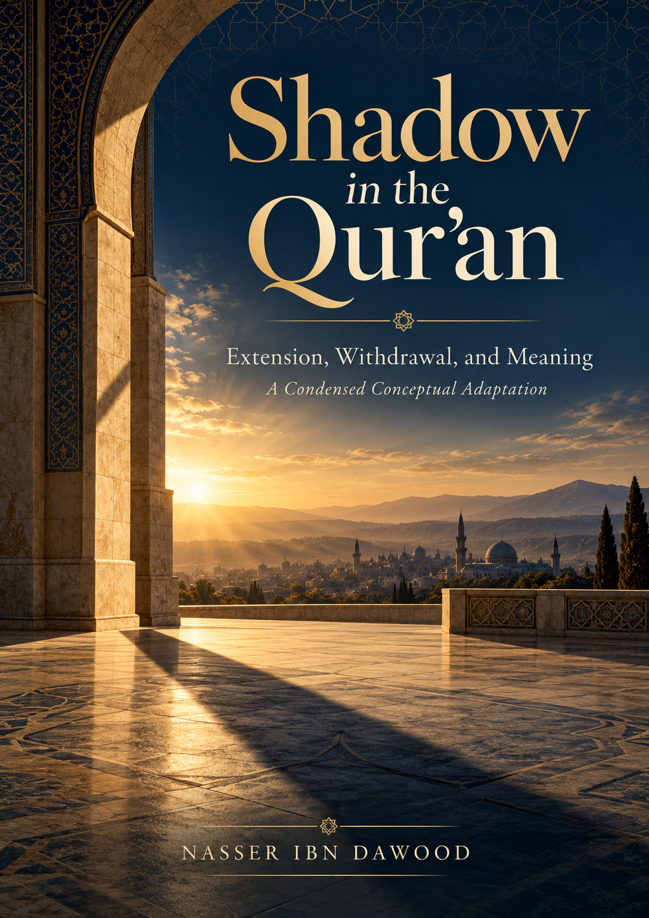
- Author
- Nasser Ibn Dawood
- Book number
- 98 / 139
- Language
- English
- Pages
- ≈ 21
- Words
- 5,200
- Reading time
- ≈ 0.5 h
- Category
- Quranic Studies
- Licence
- CC BY-SA 4.0
Page count is estimated from the text size (5,200 words); the library index records no print page count for this title.
Text extracted from the author-supplied Word edition; consult the original source.
Opening of the book
This book begins with an ordinary object of perception: shadow. We walk through it, seek it in heat, watch it lengthen and shrink, use it to estimate time, and usually move on without asking what kind of meaning the Qur’an gives to this familiar phenomenon. The central proposal of the book is not that modern physics is wrong about shadow, nor that the Qur’an is a handbook of optics. The proposal is methodological: a physical description does not exhaust a Qur’anic function, and a Qur’anic expression should not be forced into a scientific theory merely because the two speak about the same visible world.
The Arabic original belongs to a wider project called Fiqh of the Qur’anic Tongue. Here, fiqh does not mean legal jurisprudence. It refers to disciplined understanding: observing how the Qur’anic text distributes meanings through wording, contrast, context, repetition, and relational structure. The aim is to move from “What does this verse mean to me?” toward the more demanding question, “How does the text produce and constrain meaning?”
The subject of shadow is especially useful for this purpose because it lies at the intersection of several domains. It is a visible phenomenon, a linguistic field, a sign of divine ordering, a recurring image of protection and fear, a participant in verses of cosmic prostration, and an eschatological description of both bliss and punishment. This diversity creates an ideal laboratory for disciplined contemplation.
Main axes 5
- Foreword to the International Reader
- Conclusion
- Appendix A. QCROS Quick Protocol
- Appendix B. Context Map of Shadow
- Appendix C. Claim-Balance Matrix
Headings extracted from the structure of the book's text file.
Excerpt
“Have you not considered your Lord—how He extended the shadow?” The expression directs perception toward divine lordship through the phenomenon. The verb “extended” emphasizes spreading or lengthening. It should not be silently replaced by the broader verb “created,” because the choice of “extended” contributes something specific to the scene.
By Nasser Ibn Dawood — Shadow in the Qur’anTopics
- Shadow
- Shadow in the Quran
- Contemplation
Download the book
Formats: TXT · DOCX · PDF
Read the PDF on this website
Preparing the reader…