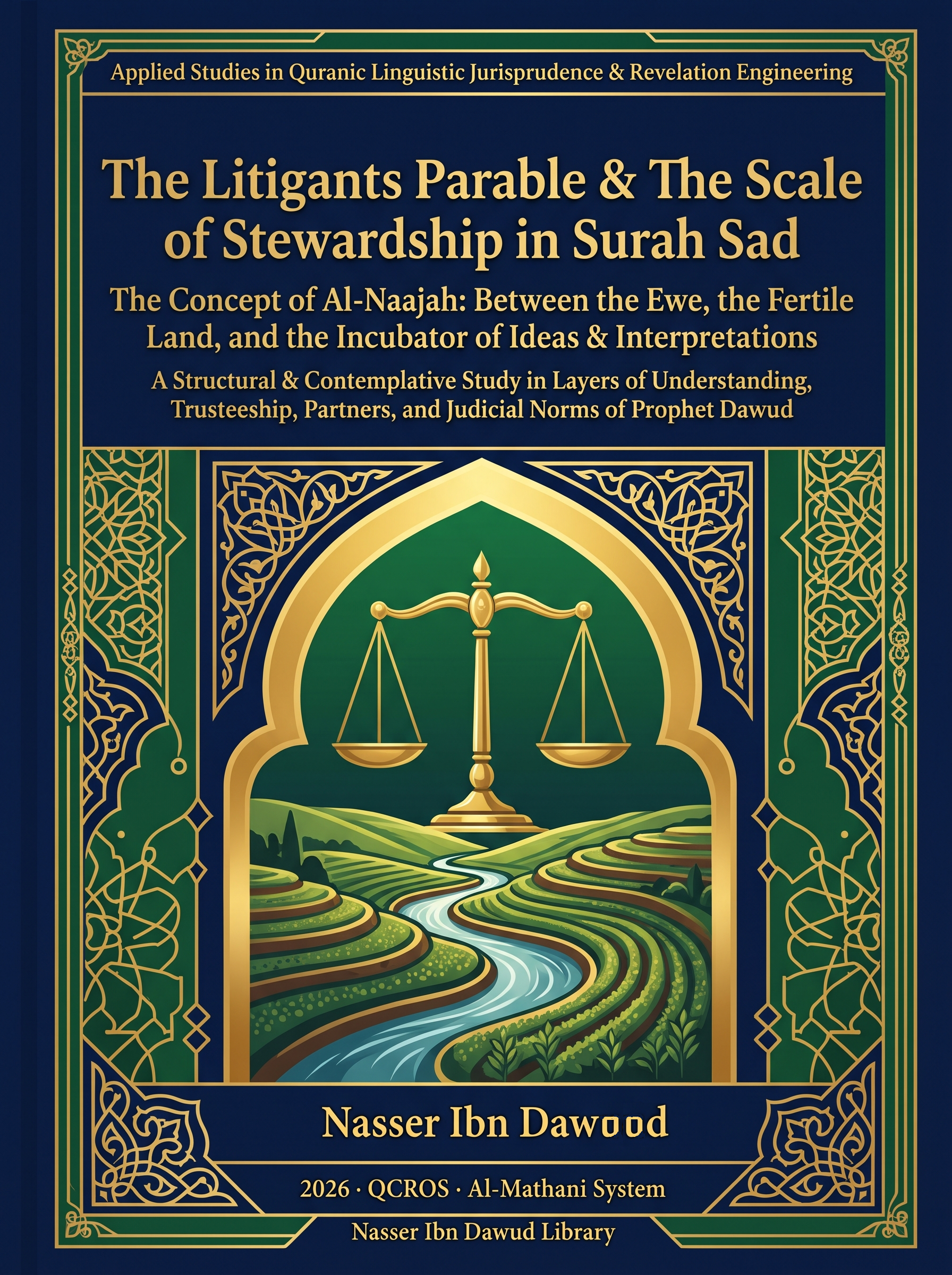
- Author
- Nasser Ibn Dawood
- Book number
- 140 / 140
- Language
- English
- Pages
- ≈ 35
- Words
- 8,745
- Reading time
- ≈ 0.8 h
- Category
- Quranic Studies
- Licence
- CC BY-SA 4.0
Page count is estimated from the text size (8,745 words); the library index records no print page count for this title.
Condensed conceptual adaptation; the Arabic work remains the primary source. Search text extracted from Word; consult the original for tables, images, and formatting. PDF is not yet available.
Opening of the book
The account of the disputants (nabaʾ al-khaṣm) in Surah Sad (verses 21–26) is short and extraordinarily concentrated. Visitors scale the wall of David’s private chamber. David is startled. They say that they are litigants, that some have wronged others, and that they seek a judgment in truth without excess. One complainant then describes an asymmetry: his brother has ninety-nine naʿajāt, while he has only one; the brother has demanded akfilnīhā and has prevailed over him in speech. David pronounces the demand unjust. The account proceeds to the wrongdoing of many associates, David’s recognition of a divine trial, his request for forgiveness, and the divine address that appoints him to rule with truth and not follow desire.
It is tempting to substitute a complete historical narrative for this deliberately compressed report. Yet the Qur’an does not specify a farm, an access road, a water source, a price offer, or the unheard litigant’s explanation. Nor does it narrate the notorious story about Uriah and a woman that appears in some exegetical traditions. Such gaps are meaningful constraints on interpretation: they permit questions but not undocumented certainties.
The book begins with the widely recognized sense of naʿjah as a ewe and tests an alternative suggested by Arabic lexical material, particularly the expression arḍ nāʿijah (an easy, level piece of land favorable to vegetation). It then develops a property-and-easement scenario to ask why a seemingly small parcel could matter to a much larger holding. Finally, it proposes a distinct cognitive application: a single independent conviction might be subject to pressure from a powerful interpretive system. The last two are research models of different kinds, not established historical or dictionary meanings of the noun in the Qur’anic account.
Main axes 30
- Introduction — Why Revisit the Word Naʿjah?
- PART ONE — THE QUR’ANIC TEXT AND THE DISPUTE
- 1. Surah Sad and the Setting of Stewardship
- 2. The Chamber, the Complaint, and the Limits of the Record
- 3. The Vocabulary: Naʿjah, Akfilnīhā, ʿAzzanī, and Khulaṭāʾ
- PART TWO — THE FIVE INTERPRETIVE APPROACHES
- 4. The Ewe as a Female Sheep
- 5. The Woman Reading and Narratives Concerning Uriah
- 6. Representation, Modern Social Readings, and the Five-Way Comparison
- PART THREE — LANGUAGE, LAND, AND A PROPOSED ROOT MODEL
- 7. What the Lexicons Actually Establish
- 8. Ramth, Level Ground, and Economic Productivity
- 9. The Consonants n–ʿ–j and the Mathani Hypothesis
- 10. From a Concrete Noun to a Proposed Unifying Description
- PART FOUR — THE PROPERTY AND EASEMENT HYPOTHESIS
- 11. Reconstructing a Property Dispute
- 12. Akfilnīhā: Care, Ownership, Administration, and Use
- 13. The Cultivated Field: David and Solomon in Surah Al-Anbiya
- 14. Why Location, Passage, and Water Can Matter
- PART FIVE — JUDGMENT, TESTING, AND COGNITIVE APPLICATION
- 15. “He Wronged You”: What the Judgment Does and Does Not Establish
- 16. The Trial of David and the Meaning of Return
- 17. The Alleged Hundred Words: A Methodological Test
- 18. Principles of Reading and the Limits of Interpretation
- 19. The Cognitive Layer: Ideas, Convictions, and Interpretive Power
- Conclusion — What This Study Establishes, Proposes, and Leaves Open
- Compact Appendix A — QCROS Claim-Status Matrix
- Compact Appendix B — How to Reproduce the Word Count
- Compact Appendix C — Glossary of Working Terms
- Compact Appendix D — Sources and a Guide for Further Study
Headings taken from the book’s own outline.
Excerpt
The author accordingly asks whether a concept can be studied at several levels without flattening their differences. At the biological level a ewe is a living reproductive animal. At the environmental or economic level land supports growth. At the cognitive level ideas mature and yield behavior. These are real analogical possibilities, but they do not form one undifferentiated semantic proof. Three layers should not be assigned equal authority merely because they share a powerful image.
By Nasser Ibn Dawood — The Disputants’ Account and the Measure of Stewardship in Surah Sad — The Concept of al-Naʿjah: From the Ewe to Productive Land and the Incubator of Ideas and InterpretationsTopics
- Surah Sad
- Disputants’ account
- Naʿjah
- Productive land
- Stewardship
- Justice
- Easement
- Qur’anic semantics
- QCROS
Download the book
Formats: TXT · DOCX
قراءة PDF داخل الموقع / Read the PDF on this website
جارٍ تجهيز القارئ… / Preparing the reader…