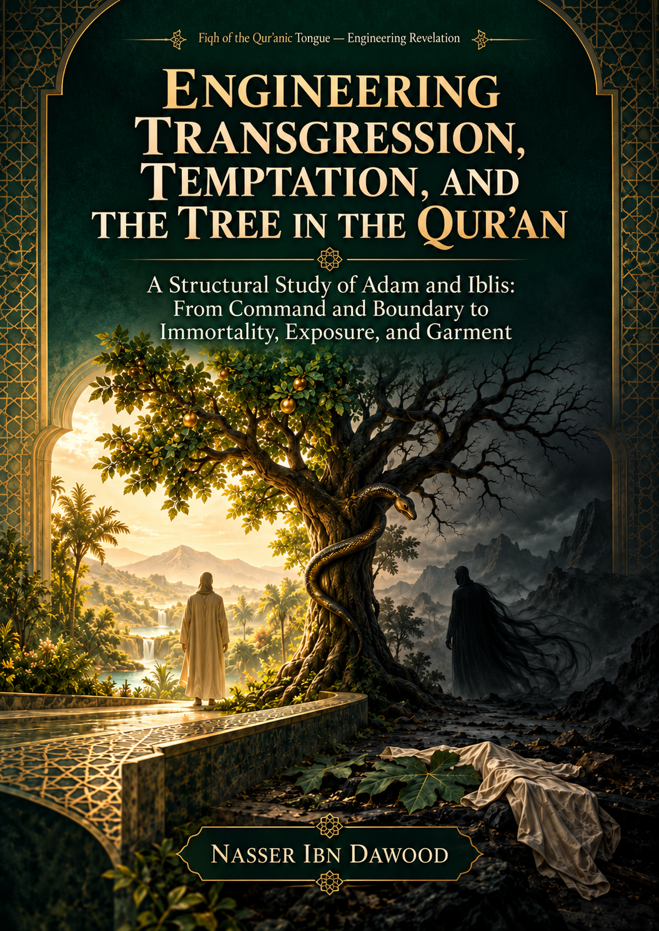
- Author
- Nasser Ibn Dawood
- Book number
- 113 / 139
- Language
- English
- Pages
- ≈ 20
- Words
- 4,914
- Reading time
- ≈ 0.5 h
- Category
- Quranic Studies
- Licence
- CC BY-SA 4.0
Page count is estimated from the text size (4,914 words); the library index records no print page count for this title.
Opening of the book
Three rules govern this adaptation. First, Qur'anic wording remains the governing evidence; earlier books by the author are treated only as sources of questions, models, or hypotheses. Second, statements spoken by Iblis are treated as speaker-limited: they are evidence that the statement occurs in the narrative, not automatic confirmation that its content is objectively true. Third, the edition preserves the research statuses used in the Arabic original: OPEN, NOT ESTABLISHED, RESISTED, SUPPORTED, STRONGLY SUPPORTED, NEAR-CLOSURE, and CLOSED.
Qur'anic references are given by surah name and verse number. Passages are generally paraphrased rather than reproduced at length. The aim is to make the structure of the inquiry portable without turning a condensed edition into a substitute for the Arabic research record.
The story of Adam and Iblis is often approached as though its major meanings were already known: the tree is assigned an identity, nakedness is given a fixed interpretation, temptation is reduced to a single psychological mechanism, and the different Qur'anic tellings are assembled into one continuous chronology. This book begins elsewhere. It treats the story as a structured textual field whose relations must be established before its symbols are defined.
Topics
- Adam
- Iblis
- Tree
- Temptation
- Garment
Excerpt
The study therefore resists an older interpretive model in which Iblis functions as a necessary catalyst of knowledge or evolution. Such a model may be philosophically suggestive, but the new corpus does not support importing it as a Qur'anic result.
By Nasser Ibn Dawood — Engineering Transgression, Temptation, and the Tree in the Qur'anDownload the book
Formats: TXT · DOCX · PDF
قراءة PDF داخل الموقع / Read the PDF on this website
جارٍ تجهيز القارئ… / Preparing the reader…