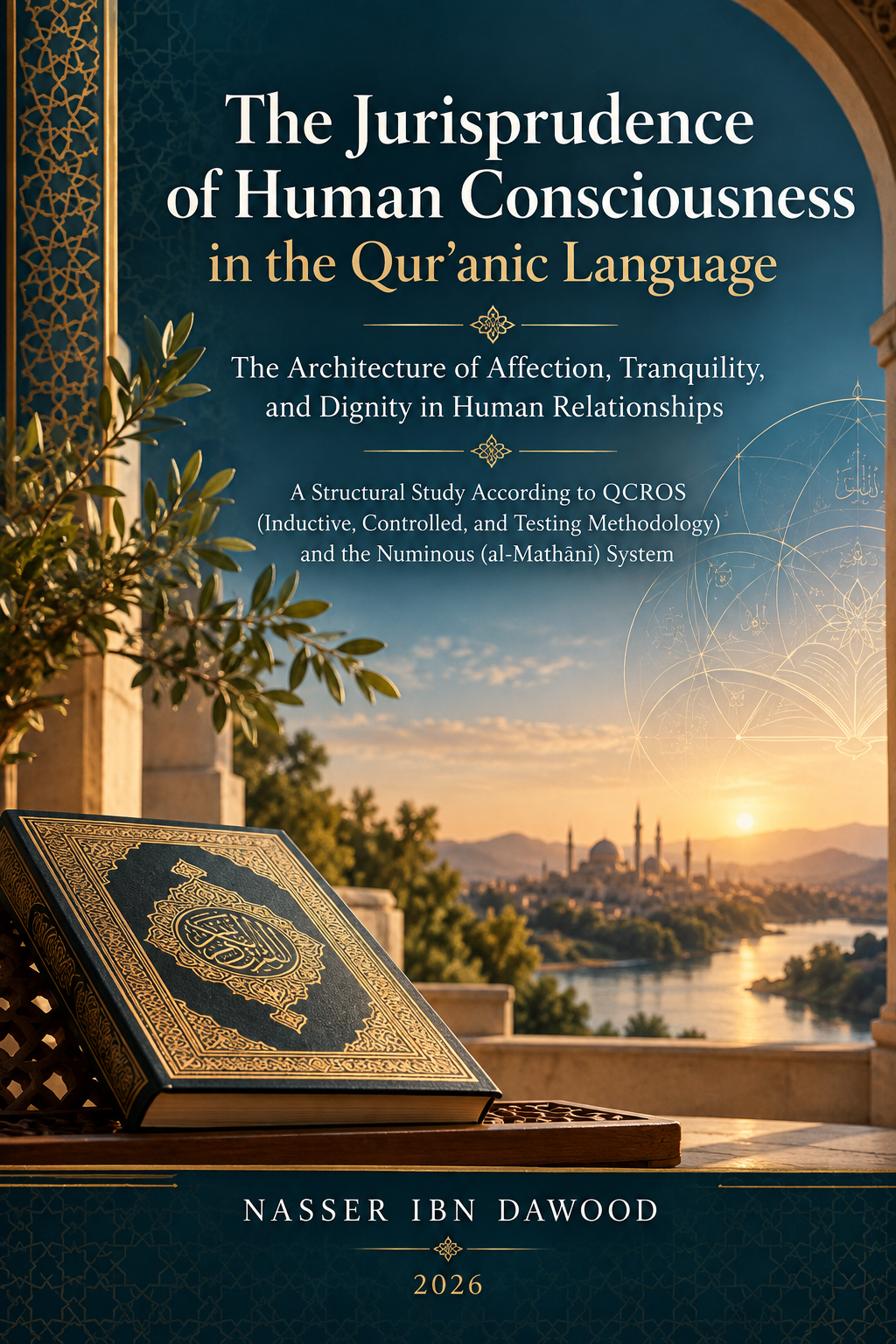
- Author
- Nasser Ibn Dawood
- Book number
- 114 / 139
- Language
- English
- Pages
- ≈ 24
- Words
- 5,954
- Reading time
- ≈ 0.6 h
- Category
- Quranic Studies
- Licence
- CC BY-SA 4.0
Page count is estimated from the text size (5,954 words); the library index records no print page count for this title.
Opening of the book
This book is not designed to deliver conclusions without showing the route by which they were reached. Its operating sequence is: READ → COLLECT → COMPARE → HYPOTHESIZE → TEST → JUDGE → CONTINUE. The reader is therefore invited to distinguish evidence from observation, interpretation, hypothesis, result, model, and law.
This study begins with a deceptively simple question: how does the Qur’an present the human being inside a relationship? The question quickly becomes linguistic, structural, ethical, and civilizational. The book does not assume that “wijdān” (human affect, inward experience, or consciousness) is a complete Qur’anic technical term. Instead, it uses the expression Fiqh al-Wijdan as an analytical container through which a network of Qur’anic terms can be tested: love, affection, tranquility, mercy, fear, grief, aversion, contentment, speech, will, mutual consent, covenant, balance, equity, justice, protection, proof, and dignity.
The inquiry moves through six interconnected parts. It first constructs the textual corpus and separates Qur’anic terms from modern analytical categories. It then studies the human agent inside the relationship, especially women as speakers, decision-makers, complainants, negotiators, and moral agents. Next it investigates balance, deprivation, short-measure, equity, and justice. It then turns to sexual boundaries, accusation, proof, rumor, privacy, verification, backbiting, and social dignity. The fifth part synthesizes these results into a model of affective dignity. The final part asks how textual findings may responsibly inspire family, institutional, educational, and civic models without converting human policy into sacred revelation.
Main axes 8
- Introduction — From Jurisprudence of Rules to Jurisprudence of Human Consciousness
- Part One — Building the Qur’anic Corpus of Human Consciousness
- Part Two — The Relationship and the Human Agent
- Part Three — The Measure of Human Relationships
- Part Four — Boundaries, Deviation, Proof, and Social Protection
- Part Five — Woman and Affective Dignity
- Part Six — From Text to Civilizational Models
- Conclusion — What This Book Establishes, and What It Leaves Open
Headings extracted from the structure of the book's text file.
Excerpt
Qur’an 24:2 names the woman and the man involved in zinā and prescribes the same stated sanction to each named party in that verse. This textual symmetry is closed within the verse, but it does not prove equal agency in every imaginable scenario of coercion, vulnerability, or incapacity. Nor does the order of naming establish a universal hierarchy of blame.
By Nasser Ibn Dawood — The Jurisprudence of Human Consciousness in the Qur’anic LanguageTopics
- Consciousness
- Affection
- Tranquility
- Dignity
- QCROS
- Mathani
Download the book
Formats: TXT · DOCX · PDF
قراءة PDF داخل الموقع / Read the PDF on this website
جارٍ تجهيز القارئ… / Preparing the reader…