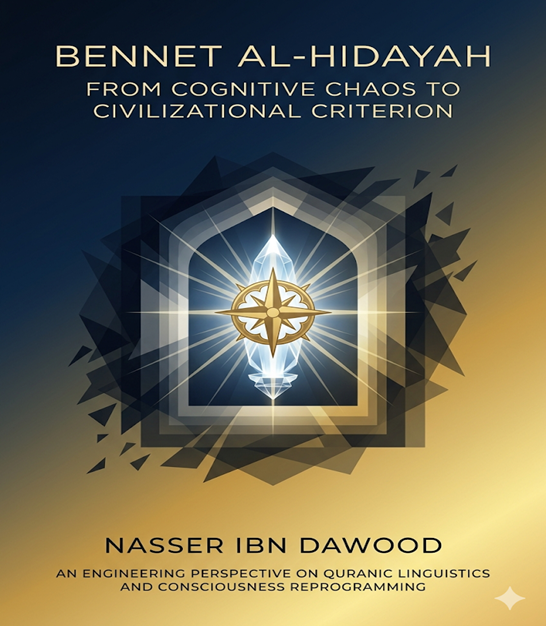
Introduction: A Crisis Not in the Text… But in Perception
The crisis of the contemporary Muslim mind lies neither in the absence of sacred texts nor in the scarcity of knowledge, but in a deeper, more subtle flaw: a flaw in the very tools of perception. The text remains present, yet its power to reshape reality has declined — not because it has lost its efficacy, but because the structure that receives it no longer functions as it should.
The Semantic Shift: Throughout history, the Quranic tongue has undergone what can be called a structural semantic shift, whereby its grand concepts have transformed from precise operational tools into loose emotional metaphors. Thus, Light (Nur) became a vague spiritual feeling instead of a perceptual standard; The Heart (Qalb) became an emotional center instead of a cognitive processing unit; and The Criterion (Furqan) became a historical memory instead of a decision-making algorithm.
Thesis of the Book: This book does not seek to offer a traditional interpretation, nor to reproduce a sermonizing discourse in modern phrasing. Rather, it stems from a radically different project: re-engineering consciousness by recovering the operational structure of the Quranic tongue. The central hypothesis is that the Holy Quran presents an integrated cognitive system that does not address emotions as an end, but reshapes the human structure of perception.
Book Summary
This work offers a structural reading of the major concepts of guidance: Light, Darknesses, the Heart, the Criterion, Purification, and Revelation. It rediscovers them not as mere linguistic terms but as functional units within an integrated system. The book moves from diagnosing the flaw (semantic shift) to understanding the processing mechanism (the Heart), then to engineering decision-making (the Criterion), and finally to activating behavior and civilization.
The book culminates in a grand final equation: Revelation → Light in the Heart → Criterion in Decision → Righteousness in Behavior → Civilization in Reality. It is an explicit invitation to move from religion as an emotional state to Islam as a life system, and from a written text to a living Quranic human being — one who sees clearly, chooses consciously, and moves with balance.
Key Features of the Book
- Redefining religion: from a belief system to an operating system
- Structural analysis of the semantic shift in major Quranic concepts
- An engineering vision of Quranic linguistics and consciousness reprogramming
- The equation of guidance: Light → Criterion → Behavior → Civilization
- Founding the science of Quranic perceptual structure
- Connecting individual perception to civilizational transformation: from the individual to righteous civilization
- A reading of Surah Al-Alaq in the age of algorithms
- A methodology combining precise linguistic analysis and an engineering spirit
Table of Contents
Foundations & Diagnosis
The System's Chapters (The Path)
The Grand Conclusion & Transformations
Epilogue & Illuminations
💡 Core Vision
“The greatest shift this book calls for is to stop treating the Quran as a 'book' and begin treating it as a 'system' – a system that rebuilds the human being, organizes relationships, and directs history. This book is not an invitation to religiosity but to enlightenment, not a project for individual salvation alone but for building a human capable of carrying light… and crafting civilization.”
— Nasser Ibn Dawood, Casablanca, April 2026
“The house is not what we inhabit, but what inhabits us. The house is not stone, but presence. The house is not a roof, but the sky of consciousness. The house is not a door to be opened, but a door to be unveiled.”