📢 Important Notice
This English edition is a condensed conceptual translation. It presents the core ideas and philosophical framework in accessible language, but does not include all the detailed discussions, linguistic analyses, and expanded references found in the original Arabic work (52 pages).
For researchers and serious readers, we recommend downloading the complete Arabic version for comprehensive understanding.
📚 Download Complete Arabic Version (52 pages)📥 Direct Download Links
📄 DOCX 📖 PDF (Direct) 📖 PDF (External) 🌐 HTML 📝 Plain Text (External) 📝 Plain Text (Direct)📖 About This English Edition
This English edition is a condensed conceptual adaptation. It presents the core ideas and philosophical framework in accessible language, but does not include all the detailed discussions, linguistic analyses, and expanded references found in the original Arabic work.
For researchers and serious readers: We recommend downloading the complete Arabic version (52 pages) and using translation tools for a comprehensive understanding.
Introduction: The Crisis of Mechanical Reading
One of the greatest paradoxes in contemporary Islamic history is this: the Muslim community received the Qur'an as a living book – something that guides, reminds, awakens, and gives life. Yet, over time, it has ended up inheriting a rigid, mechanical relationship with it. A relationship that reduces revelation to memorized narratives, scattered rulings, or cold devotional rituals, while the Qur'an's original function as a generator of consciousness, a builder of civilization, and a balancing standard for life has faded.
The Qur'an has shifted in the collective mind from "light used to see existence" to merely "a text whose vocabulary we try to understand." Here lies the crisis: the loss of connection to the architecture of revelation.
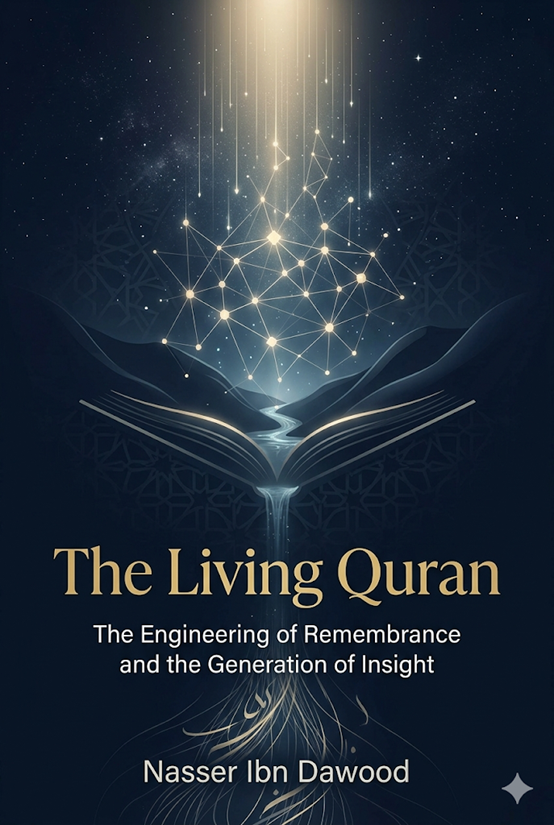
The Central Question: This book does not come to answer: "What does the Qur'an say?" Rather, it answers a deeper question: "How does the Qur'an work?" We move from the "jurisprudence of meaning" to the "jurisprudence of the mechanism of generating meaning." The Qur'an is not merely an application that performs a specific function within human life. It is an operating system that redefines life itself.
Thesis and Method of This Book
The central thesis is that the Qur'an is a guiding being, not merely a textual corpus. To demonstrate this, we will deconstruct the architecture of revelation through four levels:
- Architecture of Expression: How the Qur'an builds concepts relationally through "turning" (taṣrīf) and "paired reciprocity" (mathānī).
- Architecture of Renewal: The secret of the "ever‑new remembrance" (al‑dhikr al‑muḥdath) – how the text remains fixed while the discourse remains present.
- Architecture of Reception: Analyzing the conditions for "opening" (fatḥ) and how the Qur'an reshapes the reader before delivering information.
- Architecture of Transformation: Tracing the path from mere reading to penetrating insight (baṣīrah).
Key Features
- Diagnosis of the "mechanical reading" crisis in contemporary Islamic consciousness
- Introduction of the concept of "Second Illiteracy" as a critical tool
- "Architecture of Revelation" methodology for understanding how the Qur'an works
- Secret of the "ever‑new remembrance" – fixed text, perpetually present discourse
- Protocol of reception and the expansion of the heart's "valleys"
- Applied models: Spirit (Rūḥ), Dominion (Malakūt), Self (Nafs), Men and Women
- Methodological comparison: functional hermeneutics vs. juristic and feminist readings
- Conceptual glossary for the "Architecture of Revelation"
Table of Contents
Grand Conclusion: The Qur'an – A Being, Not a Corpus
The final outcome of this book is a redefinition of our relationship with revelation.
- The Qur'an is not a corpus we return to when we need a legal ruling. It is a being we accompany so that it shapes our very being.
- The Qur'an is not a silent text we control through interpretation. It is a living system that controls the quality of our consciousness.
The era of treating the Qur'an as a "historical book" or a "book of blessing" is over. The era of reclaiming it as an operating system for existence has begun. A community that possesses the "architecture of revelation" cannot be defeated epistemologically. A heart that receives the "ever‑new remembrance" cannot grow spiritually old.
Final conclusion: The purpose of the Qur'an is not to be finished by the tongue; it is to be resurrected within the being. If you read and do not change, re‑examine your "valleys"; for the sky is still raining, and revelation is still alive.
Back Cover Summary
Do We Read the Qur'an or Merely Repeat It?
Contemporary consciousness has inherited a "mechanical" relationship with revelation. The Qur'an is treated either as a rigid code of rulings that fell silent at the moment of revelation, or as a fluid spiritual space with no controls. Between rigidity and fluidity, the great secret has been lost: it is a living book.
This book dismantles the architecture of revelation, moving from traditional "jurisprudence of meaning" to the "jurisprudence of how meaning is generated." The Qur'an is not an application added to your life; it is an operating system for consciousness.
Read to transform, not just to know.
About the Author
Nasser Ibn Dawood is an Islamic researcher and engineer specializing in digital Qur'anic studies. His work focuses on bridging traditional Islamic scholarship with contemporary linguistic and philosophical analysis, making classical Islamic concepts accessible and relevant to modern readers across cultural boundaries.
📧 Contact: nasserhabitat@gmail.com