📥 Direct Download Links
📄 DOCX 📖 PDF (direct) 📕 PDF (external) 🌐 HTML 📝 TXT (direct) 📄 TXT (external) 🗄️ Archive.org🍃 Translator's Note: The Bridge of Meaning
This English edition is a condensed conceptual adaptation. It is not a word-for-word translation, but rather an "extraction of essence." It presents the core philosophical framework in accessible English, omitting the exhaustive linguistic debates and classical references found in the original Arabic text.
For the academic researcher: The original Arabic version (264 pages) remains the primary source for comprehensive linguistic analysis, detailed exegesis, and the complete bibliography.
📌 Core Problematic
The dominant interpretive traditions often treat words as isolated units, relying on inherited definitions without re-examining their linguistic structure. This leads to a chain of distortion: Misdefined concepts → Distorted reading → Fragmented methodology → Confused consciousness → Misguided practice.
The project of Fiqh Al-Lissan Al-Qur'ani seeks to reverse this chain by reconstructing meaning from within the Qur'anic linguistic system itself.
✨ Methodology: From Letter to System
- Letter (Harf) – minimal unit of meaning potential
- Pair (Mathani Structure) – relational generation of meaning
- Root (Jidhr) – dynamic semantic field
- Word (Kalima) – contextual activation
- System (Nasaq) – integrated network of meaning
This progression moves from micro-structure to macro-structure, revealing the Qur'an as a coherent semantic architecture.
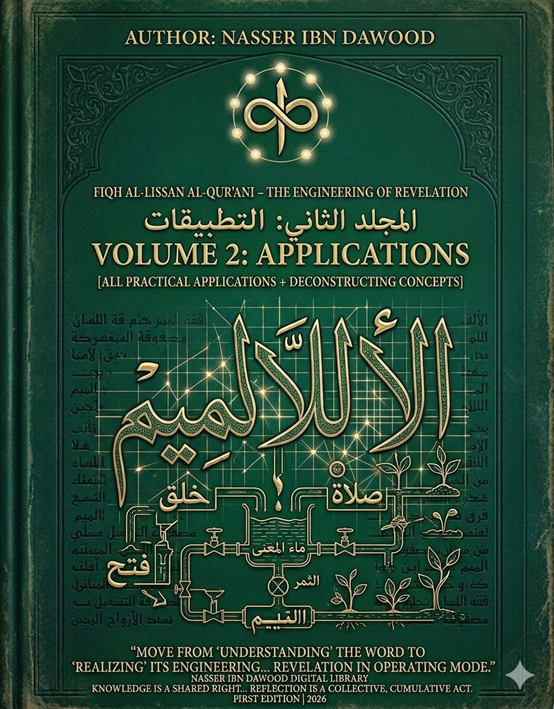
⚙️ Examples of Conceptual Deconstruction (Volume 2)
- Prayer (Ṣalāh): From ritual act → regulatory system of consciousness and time
- Creation (Khalq): From past event → continuous divine engineering
- Shortening of Prayer (Qaṣr): Legal concession → structural adaptation in travel
- Victory (Fatḥ): Military conquest → existential and cognitive opening
- Kindness (Rifq) & Effort (Jahd): A binary balance governing human behavior
- Qur'anic Stories: Moses, Abraham, Joseph – read as integrated semantic systems
Over 150 applied studies are presented, each following the five‑step reconstruction framework: common definition → identification of distortion → linguistic analysis → precise redefinition → impact on understanding and practice.
📑 General Table of Contents (Volume 2)
🎯 What You Will Gain After Completing This Volume
You will have trained yourself to apply “Fiqh Al-Lissan” to any Qur'anic concept. You will see that prayer is not just movements but a system of consciousness regulation; that creation is not a past event but an ongoing law. You will become an engineering reader, not a consumer of ready-made interpretations.
💬 Author's Concluding Statement
“This series is an attempt to bring the Muslim mind out of the ‘history museum’ and into the ‘operation lab.’ We have placed the tool in your hands (Volume 1), trained you on it (Volume 2), shown you the grandeur of the total design (Volume 3), and now we open the door to activation (Volume 4). The Qur'an does not change the world through static words, but through living systems that operate within ‘those of understanding.’”
— Nasser Ibn Dawoud
“A Book We have sent down to you, blessed, that they may ponder its verses, and that those of understanding may remember.” (Qur'an 38:29)