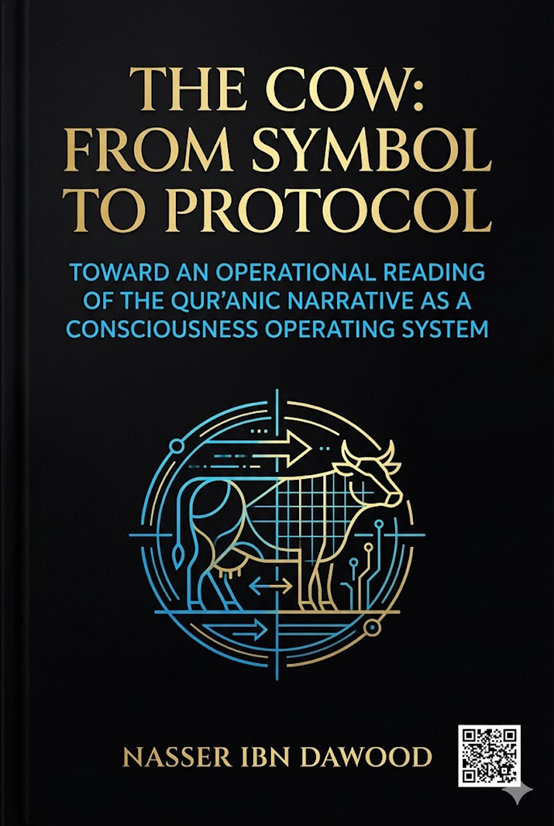
📘 Translation Notice
This English edition is a condensed conceptual summary. It presents the core ideas and methodological framework in accessible language, but does not include all the detailed linguistic analyses, expanded discussions, and appendices found in the original Arabic work (85 pages).
For complete study, please download the full Arabic version from the links below or use translation tools.
📥 Direct Download Links
📄 DOCX 📖 PDF (Direct) 📖 PDF (External) 🌐 HTML 📝 Plain Text (External) 📝 Plain Text (Direct)Introduction: The Central Problem
For centuries, Islamic consciousness—in its interpretive and educational manifestations—has treated Qur'anic stories as historical records or moral lessons, without penetrating the deep cognitive structure that organizes these narratives within the Qur'anic system. This reading has reduced the operational function of the text, transforming the Qur'an from a living structure for reshaping human beings into a text recited for blessing or cited as evidence.
This crisis is clearly evident in how the story of "the Cow" is approached. It is often read as an event that happened to the Children of Israel, involving a divine command to slaughter a cow to solve a mysterious murder. Then—at best—a lesson is extracted about obedience or avoiding excessive questioning. However, this level of reading, while partially correct, keeps the text on its surface and neglects the possibility that the story itself is part of a cognitive protocol aimed at redesigning human perception.
The central question of this book:
Can "the Cow" in the Qur'an be read not merely as a physical animal or historical event, but as a structural symbol within a Qur'anic system that works to dismantle rigid tradition, revive dormant consciousness, and reboot collective intelligence?
This book proposes a five-level integrated methodology: lexical analysis, letter analysis, structural analysis (Mathani), symbolic reading, and functional-civilizational analysis. Its goal is to transform the Qur'anic story from historical memory into an operational algorithm for redesigning human beings.
Key Features
- Deep lexical analysis of the root B-Q-R (splitting, exposing, seeking)
- Letter‑level analysis of B, Q, R as a meaning algorithm
- Study of Mathani (paired structures) within words and the whole text
- Symbolic reading of the Cow, the Calf, and Mount Tur as a map of consciousness
- Connection to purification (Tazkiyah) and human stewardship (Istikhlaf)
- Practical appendices: spiritual practices, visual diagrams, daily protocol, 30‑day program
- Methodological controls against arbitrary symbolic interpretation
Table of Contents
Conclusion: The Cow as an Operating Protocol
This book has traced a journey:
From the root (B-Q-R) → to the letters (B, Q, R) → to the paired structure (BAQ + QAR) → to text → to symbol → to network of symbols → to operating system.
The cow story is not about an animal. It is a cognitive protocol for:
- Dismantling rigid traditions
- Exposing hidden realities
- Reviving dormant consciousness
- Reordering collective and individual intelligence
The ultimate goal is to demonstrate that Qur'anic stories are not just historical memory but operational algorithms for redesigning human beings.
What threatens our age is not just the "calf" in its modern forms, nor the "cow" in its cultural manifestations, but the absence of Tur—the absence of a project of ascent.
From here begins the real journey: reading the Qur'an not as history, nor as law alone, nor as mere moral exhortation, but as consciousness engineering, an operating system, a liberation protocol, and a vicegerency program.
"He has succeeded who purifies it, and he has failed who buries it" (91:9-10)
About the Author
Nasser Ibn Dawood is an Islamic researcher and engineer specializing in digital Quranic studies. His work bridges traditional Islamic scholarship with contemporary linguistic and philosophical analysis, making classical Quranic concepts accessible to modern readers across cultural boundaries. All his works are available under Creative Commons licenses on his digital library.