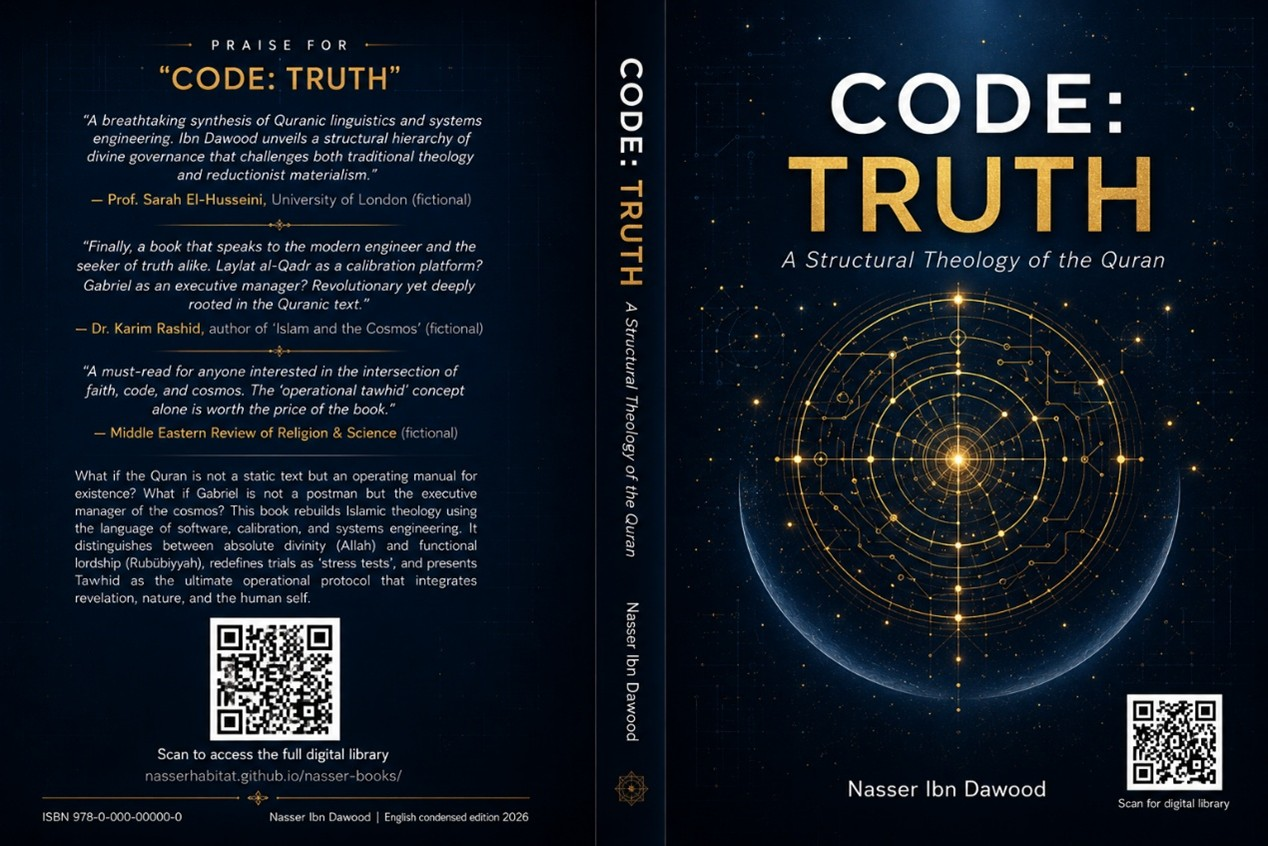
Important Translation Notice
This English edition is a condensed conceptual and semantic translation.
For the complete Arabic version with detailed discussions, expanded references, and comprehensive analysis (over 230 pages), please download the original Arabic book from our library.
You can use instant translation tools for real-time translation of the complete Arabic text.
📚 Download Complete Arabic Version (230+ pages)This English version provides the conceptual framework and main arguments in accessible language.
Translation Information
This English edition is a condensed conceptual adaptation. It presents the core ideas and philosophical framework in accessible language, but does not include all the detailed discussions, linguistic analyses, and expanded references found in the original Arabic work (236 pages).
For researchers and serious readers: We recommend downloading the complete Arabic version and using translation tools for a comprehensive understanding. The Arabic version includes complete linguistic analysis, detailed exegesis, structural diagrams, and extensive footnotes.
Preface: Why This Book Now?
Contemporary human thought faces a sharp epistemological crisis in the religious domain: a crisis of perception, language, and methodology. The image of God in popular consciousness is confused between ancient myth, dry philosophy, and cold scientism. The basic Quranic terms – Rabb (Lord), Ilah (God), Throne, Kingdom, Decree – have become alien to the modern mind. A separation has been made between the Universe, the Quran, and the Self, leading people to think science is one thing and religion another.
This book comes to rebuild the broken bridges, in the language of our time, with a structural engineering methodology that addresses the engineer, the scientist, and the seeker of truth alike.
The Quran offers a fourth vision, completely different from mythical, philosophical, or technical-scientific conceptions: a Living, Self-Sustaining God, nothing like Him, Lord of the worlds, Most Gracious, Most Merciful, Apparent in His effects, Hidden in His essence. This book attempts to close the gap between what people believe about God and what the Quran wants us to believe.
What distinguishes this book is the methodology of "Linguistic Jurisprudence" – discovering the internal semantic system of the Quran – and structural engineering that views the Quran, the universe, and the human being as an integrated system. It is not a traditional commentary, but an engineering deconstruction of the System of Truth, designed to serve as an "Operating Manual" for human consciousness.
Key Features
- Linguistic Jurisprudence (Fiqh al-Lisan): Deconstructing the internal semantic system of the Quran
- Structural Engineering: Viewing Quran, Cosmos, and Self as one integrated system
- Liberation of the Divine Concept: Beyond mythical anthropomorphism and philosophical abstraction
- Lordship vs. Divinity: Distinguishing Rububiyyah from Uluhiyyah, exposing modern idolatry
- Laylat al-Qadr: The cosmic calibration platform before the Big Bang
- Engineering of Trials (Balā’): Redefining affliction as stress-test and self-calibration
- Cosmic Management Hierarchy: From the Throne to angels to natural laws to the human operator
- Visual diagrams and summary tables for easy understanding
Table of Contents (Condensed)
Core Thesis: The Night of Decree as Calibration Platform
This book presents a radical yet rigorous thesis: The universe is not dumb matter that exploded by chance. It is a majestic operating system whose code, constants, and laws were set in a single hidden moment we call the "Night of Decree" (Laylat al-Qadr). That night was not merely a date on a calendar; it was a Calibration Platform that preceded the Big Bang. The physical constants – the speed of light, gravitational force, quantum thresholds – are not random accidents but hard-coded software instructions ensuring the stability of the cosmic system.
Within this framework, trials (balā’) are not punishments but stress tests designed to calibrate the human soul. The human being is not a passive observer but a System Operator entrusted with tools to decode both revelation and the universe simultaneously. Monotheism (Tawhid) is not a sentence you say; it is a protocol you run – connecting the Manifested Universe, the Written Quran, and the Perceived Human into a single coherent narrative.
Epilogue: A Final Invitation
This book is an open draft, not a sacred text. Every idea is open to revision, criticism, addition, and deletion. Certainty belongs only to the Quran itself – never to any human understanding. The author invites every thoughtful reader – whether in agreement or disagreement – to become a partner in this cumulative intellectual project. Not an opponent who shuts the door, nor a follower who lacks insight. For truth does not fear criticism, and light is not extinguished by objections.
Nasser Ibn Dawood – Digital Library – January 2026
About the Author
Nasser Ibn Dawood is an Islamic researcher and engineer specializing in digital Quranic studies. His work focuses on bridging traditional Islamic scholarship with contemporary linguistic and philosophical analysis, making classical Islamic concepts accessible and relevant to modern readers across cultural boundaries. All his works are available under Creative Commons licenses at: https://nasserhabitat.github.io/nasser-books/