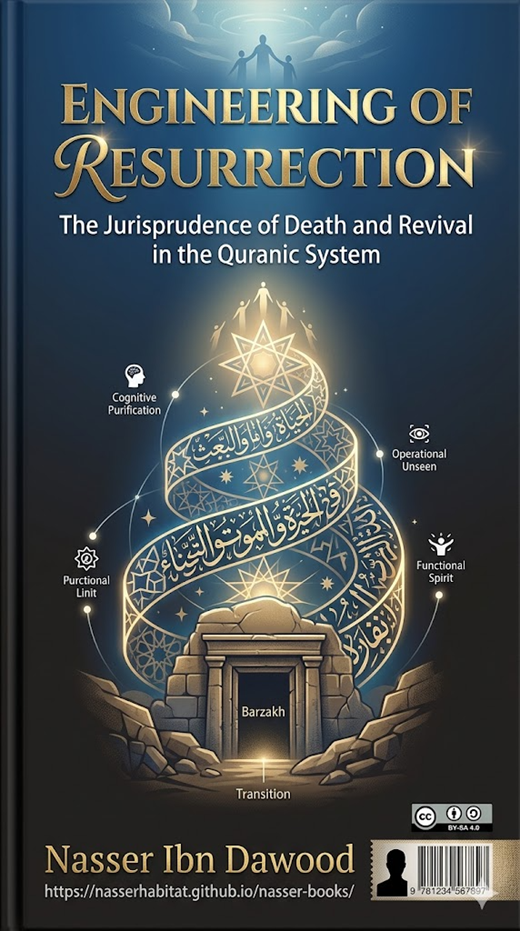
⚠️ Important Note – Condensed English Edition
This English version is a condensed conceptual summary (23 pages) of the original Arabic work (130 pages). It presents the core framework and main arguments in accessible language, but does not include all detailed linguistic analyses, extended exegesis, or the comprehensive appendices.
For researchers and serious readers, we strongly recommend downloading the complete Arabic version from the links below.
Introduction: Beyond the Fear of Annihilation
For centuries, death has been the ultimate human terror – a black hole that swallows all meaning. Traditional readings either saw it as sheer nothingness (materialism) or wrapped it in a fog of mystery and intimidation (folk religion). But when we approach the Quranic text with a "sharpened eye" – what this book calls the "Iron Sight" – we discover that death is not an end. It is a law of transition, a functional phase within an existential engineering designed by the Creator.
This book is not a conventional sermon about the afterlife. It is a "User Manual" that dismantles the structure of death and revival as functional stages that the human "self" (Nafs) passes through. We are not dealing here with a descriptive unseen, but with an operational unseen – laws that govern our movement right now.
Functional Non‑Existence ⮕ First Revival ⮕ Trial (Striving) ⮕ Death (Archiving) ⮕ Resurrection (Re‑Emission) ⮕ Gathering (Hashr) ⮕ Judgment (Qiyamah) ⮕ Recompense (Final Stability)
Why "Engineering of Resurrection"?
Because resurrection is not merely rising from graves. It is:
- Cognitive resurrection – freeing the mind from the illusion of non‑existence.
- Functional resurrection – redefining life as a testing ground (sandbox) with a clear purpose.
- Civilizational resurrection – using the understanding of death to build a human being who invests in "excellence of action" with certainty of the final outcome.
Key Features of the Book
- Semantic deconstruction of death, resurrection, barzakh, and grave as archive
- Distinction between descriptive unseen and operational unseen
- Functional lexicon: first death, second death, tasting death, functional life
- Abrahamic Quadration (four birds) and Jesusian healing as protocols of revival
- Analysis of sensory hearing vs responsive hearing
- Scales of justice as technical evaluation of deeds
- The "Resurrection Human" as a model for civilisational renewal
Table of Contents (English Summary)
For complete detailed index (over 100 entries), please refer to the Arabic full version.
Conclusion: Toward a Renewed Resurrection Consciousness
The goal of this book is to shape the "Resurrection Human" – one who does not wait for resurrection as a distant unseen event, but lives it as a daily state of awareness.
Qualities of the Resurrection Human:
- Kills their old ideas – has the courage to dismantle knowledge systems that have lost validity.
- Revives their new ideas – applies the protocol of revival through connecting to laws and field action.
- Moves with awareness – knows that life is not the opposite of death, but the result of correctly managing the transition from stillness to striving.
Final Golden Rules:
- Unity of source and destination – You start from functional non‑existence and end at the final end. Everything between is a cognitive laboratory.
- Centrality of functional spirit – True death is the cessation of agency. A nation that produces no values is dead even if it walks in markets.
- The inevitability of engineering accounting – The scales of the Hereafter are a precise technical evaluation of the mass of sincerity and the weight of truth.
- Freeing consciousness from the illusion of annihilation – Knowing that you taste death and do not cease gives you civilisational courage.
We end with the certainty with which we began: "And that to your Lord is the final end" (Quran 53:42). So towards that final end, let us race in excellence of deed, purity of intention, and strength of resolve.
About the Author
Nasser Ibn Dawood is an Islamic researcher and engineer specializing in digital Quranic studies. He develops the methodology of "Quranic Linguistic Jurisprudence" (Fiqh al-Lisan al-Qur'ani) to deconstruct classical texts and extract their operational laws. His works are available for free under Creative Commons licenses.
📚 Digital Library: https://nasserhabitat.github.io/nasser-books/