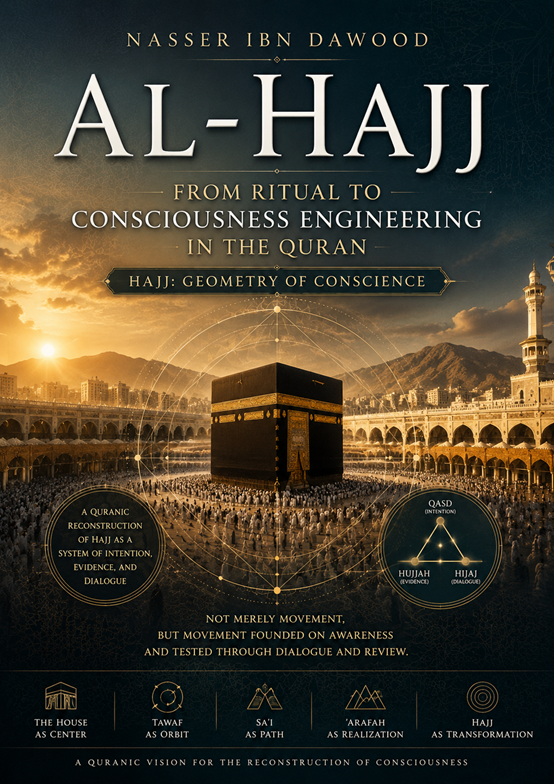
Important Note on This English Edition
This English edition is a condensed conceptual adaptation of the original Arabic book. It presents the core ideas, philosophical framework, and key structural insights in accessible language, but does not include all detailed linguistic analyses, expanded footnotes, and appendices found in the complete Arabic work.
For the complete Arabic version (94 pages) with full methodological tools, deep root analysis (Ḥ-J-J), and advanced reflections, please download from our library.
📚 Download Complete Arabic Version (94 pages)This English version provides the conceptual framework and main arguments for English readers.
📥 Direct Download Links
📄 DOCX 📖 PDF (Google Drive) 📖 PDF (Direct) 📝 Plain Text (TXT) 📝 Plain Text (Direct) 🌐 Archive.orgTranslation Information
This English edition is a condensed conceptual adaptation. It presents the core ideas and philosophical framework in accessible language, but does not include all the detailed discussions, linguistic analyses, and expanded references found in the original Arabic work.
For researchers and serious readers: We recommend downloading the complete Arabic version (94 pages) and using translation tools for a comprehensive understanding. The Arabic version includes:
- Full methodology of Quranic Linguistic Fiqh (Fiqh al-Lisan)
- Deep analysis of the root Ḥ-J-J (ح ج ج)
- Detailed exegesis of all relevant verses
- Appendices on symbolic interpretation controls
- Critical reflections on contemporary Hajj practices
Introduction: Why Re-read Hajj?
For centuries, Hajj has been understood in Muslim consciousness as a ritual – a set of physical actions performed at a specific time and place. This understanding is correct at its level, but it may be only one layer of a deeper semantic structure.
This book asks a provocative question: Has the meaning of Hajj exhausted itself at the ritual level? Or is what we perceive today merely one stratum of a wider, deeper intentional structure?
The problem is not in the Quranic text itself, but in the tool through which it has been read historically. Hajj was fixed within a closed ritual framework, while the Quran may point to a deeper dimension: one that transcends spatial movement toward cognitive movement, and exceeds external action toward the inner structure of consciousness.
This project does not seek to demolish traditional meaning, but to reconstruct it within its holistic horizon – transforming understanding from an "isolated rite" into a "moving cognitive structure" within the Quranic system.
Book Summary
Central Problem: Has the meaning of Hajj exhausted itself at the ritual level, or is what we perceive today merely one stratum of a wider, deeper structure? The book argues that the problem is not in the Quranic text but in the historical reading tool. Hajj was fixed within a closed ritual framework, while the Quran points to a dimension that transcends spatial movement toward the internal structure of consciousness.
Methodology: The book employs Quranic Linguistic Fiqh (Fiqh al-Lisan al-Qur'ani), a structural analytical method based on: moving from lexical to structural analysis, building relationships between concepts in a single semantic network, extracting the operational function of meaning, and respecting the literal while opening the horizon for deeper layers.
Redefining Hajj: Hajj is redefined as: Hajj = Intentional Direction (Qasd) + Evidence (Hujjah) + Dialogic Argumentation (Hijaj). Thus, it is not merely going to a place, but conscious movement toward a semantic center, knowledge-building based on proof and certainty, and a dialogic interaction that tests and reorganizes consciousness.
Major Concepts Re-read: The House (Bayt) as semantic center reorganizing perception of the world; Tawaf as existential model of movement around a fixed center that dismantles ego-centricity; Sa'i as translation of consciousness into action; Taqwa as internal balance and self-regulation system; Security (Amn) as stabilization of consciousness within itself; Provision (Zad) as existential capital (Taqwa).
The Essential Transformation: The book aims to move the reader from interpretation to engineering, from ritual to transformation, from event to system.
Final Result: Hajj is not what a person does once in a lifetime, but what a person can become throughout life. It is a comprehensive Quranic model for reengineering the human between center, movement, and meaning, so that all existence becomes a conscious tawaf around the Truth.
Chapter 1: The Linguistic Foundation – Root (H-J-J)
The root Ḥ-J-J (ح ج ج) in Arabic does not only mean "intentional direction" (qasd), but rather: Intentional direction founded on evidence (hujjah) and realized through dialogic argumentation (hijaj). Thus, Hajj is not merely physical movement, but a system combining intention, proof, and dialogue.
This deep linguistic structure reveals that the ritual of Hajj is a physical enactment of a cognitive and argumentative process. The pilgrim (hājj) is one who directs their entire being toward a center of meaning with evidence and conscious engagement.
Chapter 2: The Human as a "Tawaf-ing" Being
If Tawaf appeared in Hajj as a ritual movement, at this deeper level it transforms into a description of the human being itself:
- Tawaf as existential model: Humans do not live in a straight line – they return to their values, circle their meanings, constantly review their center.
- Tawaf as circular consciousness: not linear progress alone, but perpetual movement between experience and meaning.
- Human between center and movement: not separate from their center, not ceasing motion around it.
Thus, the human being becomes: a tawaf-ing being – never stable except within conscious movement around a fixed meaning.
Chapter 3: Center of Monotheism vs. Circles of Dispersion
This axis represents the deep philosophical structure of Hajj as an existential model:
- Center of monotheism: point of meaning collection, direction reference, unity of perception – the idea that existence has one center that reorganizes multiplicity.
- Circles of dispersion: multiplicity without center, movement without direction, knowledge without unity.
- Hajj as reorganization: the process of transferring the human being from circles of dispersion to the center of monotheism – not merely spatial transition, but reconstruction of consciousness, resetting of direction, reunification of the human interior.
Conclusion: Hajj: From Place to Meaning
This is the final conclusion of the entire project:
- Place as beginning: Hajj begins from a specific place, but does not end there.
- Transcending place: in deep structure, place transforms into symbol, center, tool for producing meaning.
- Meaning as ultimate destination: the goal is not arrival at place, but arrival at a new state of perceiving existence.
- The final transformation: Hajj in its complete form is – from movement in place → to movement within meaning → to the reshaping of the human being itself.
The book does not end as a closure, but as the beginning of a new understanding: Human beings are not static in the world, but in perpetual motion toward a center of meaning that constantly reshapes them.
Hajj, as revealed in this book, is not a historical event, nor an isolated ritual, nor merely a legal system – but rather a comprehensive Quranic model for the engineering of human beings between center, movement, and meaning, so that all of existence becomes a conscious tawaf around the Truth.
Table of Contents (Condensed English Edition)
Note: The complete Arabic edition includes detailed verse analysis, appendices on symbolic interpretation controls, and expanded methodological discussions.
About the Author
Nasser Ibn Dawood is an Islamic researcher and engineer specializing in digital Quranic studies and Quranic Linguistic Fiqh (Fiqh al-Lisan). His work aims to build new methodological tools for understanding the Quranic text as an operating system for consciousness, not merely a sacred text for recitation. All his works are available under Creative Commons licenses.