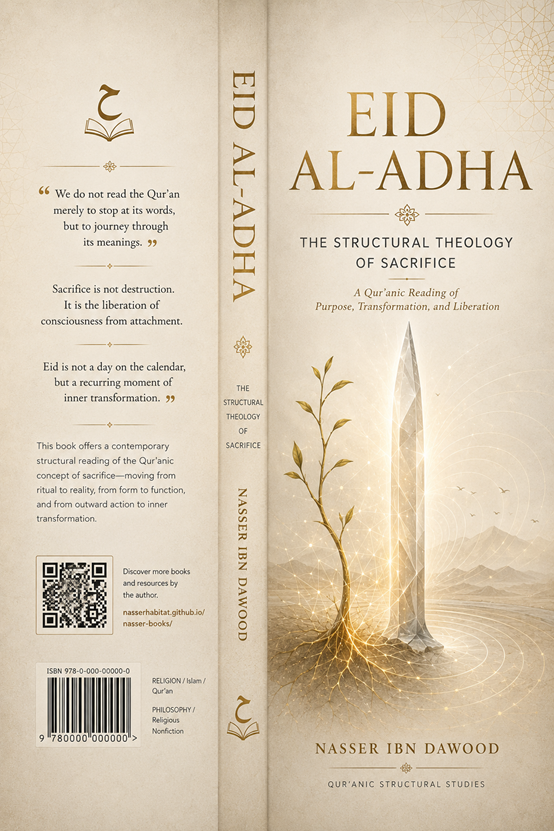
Important Notice
This English edition is a condensed summary (12 pages) of the complete Arabic work.
The full Arabic version (199 pages) contains the complete structural analysis, detailed linguistic deconstruction of letter-pairs (al-mathānī), extensive diagrams, and the entire "Fiqh al-Lisān al-Qur'ānī" methodology.
For serious researchers, we strongly recommend downloading the Arabic original and using translation tools for a comprehensive understanding.
📚 Download Complete Arabic Version (199 pages)This English version provides the core conceptual framework and main arguments.
📥 Direct Download Links (English Summary)
📄 DOCX 📖 PDF (Direct) 📖 PDF (Backup) 🌐 HTML 📝 Plain Text (External) 📝 Plain Text (Direct)About This English Edition
This English version is a concise summary (12 pages) of the original 199-page Arabic work. It presents the core ideas, methodological framework, and main conclusions, but does not include the full linguistic dissections, extensive diagrams, detailed exegesis of Quranic passages, or the comprehensive appendices.
For a thorough understanding of the "Suggestive-Structural Contemplation" (al-tadabbur al-īḥā’ī al-binyawī) method, the deconstruction of letter-pairs (al-mathānī), and the full "Fiqh al-Lisān" analysis, please refer to the complete Arabic version.
Preface: From Ritual to Existential Path
This book is neither a traditional defense of the sacrifice ritual nor an attempt to abolish or empty it of its material substance. Nor is it a repetition of inherited jurisprudential discourse in its usual form. It starts from a much deeper question than the question of "ruling" – it attempts to return to the Quranic structure from which the ritual was born, before layers of history, custom, and social struggle accumulated upon it.
The crisis of contemporary religious consciousness lies not only in the weak commitment to rituals but also in their reduction to apparent forms, until many devotional practices move within a conceptual vacuum: the body remains present while the function disappears, rituals continue while their effect on building the human being and society stalls.
The central question: How did sacrifice transform from a Quranic system for rebuilding the human being and liberating his relationship with matter and ownership, into a practice sometimes reduced to blood, meat, and social conformity? This book reads Eid al-Adha not as a seasonal occasion, but as a dense Quranic model for understanding the relationship between the human being, matter, giving, sacrifice, liberation, and civilisation.
Methodological Foundation: Suggestive-Structural Contemplation
This book presents a contemporary reading of the Quranic text based on a method called "Suggestive-Structural Contemplation" (al-tadabbur al-īḥā’ī al-binyawī). It differs from classical exegesis as well as from loose esoteric interpretation or forced scientific projections.
Core Principles:
- The Quran begins with the physical to build meaning: It does not negate the material world (blood, meat, sleep, slaughter) but uses it as a launchpad toward deeper existential and spiritual dimensions.
- The Quranic word operates in layers: Sensory/pragmatic level, structural/functional level, and purposive/existential level. The first layer is never cancelled; we build upon it.
- Deconstructing "Letter Pairs" (al-Mathānī): Breaking down triliteral roots into binary pairs to uncover energetic and functional movements (e.g., dhabḥ → dhb + ḥ).
- The Law of Functional Opposition: Understanding a term through its opposite within the Quranic system (e.g., dead vs. purified).
What this method is NOT: Esoteric disconnected interpretation, classical morphological derivation as a rigid rule, or forced scientific projection. The ultimate criterion is coherence with context and with established Quranic principles.
About This Book
Eid al-Adha is often understood merely as the "Festival of Sacrifice" – an annual commemoration of Abraham's willingness to sacrifice his son. But what if the ritual of sacrifice (udhiyah) carries a much deeper structural meaning? What if the Quran uses the physical act of slaughter to teach a method of existential liberation: the slaughter of attachment, of ego, of hoarding, and of fear?
This book proposes a structural reading that moves from the physics of blood and meat to the engineering of spiritual growth and social redistribution. Using the tools of Suggestive-Structural Contemplation, it analyzes key concepts: blood (dam), flesh (lahm), sacrifice (dhabḥ/nahr), purification (tadhkiyah), the Abrahamic vision (manam), and redemption (fidā').
The book also critiques contemporary distortions: the reduction of sacrifice to social display, the hoarding of meat, the environmental and economic pressures, and the loss of the ritual's original purpose – redistributing mercy and breaking the cycle of accumulation.
Key Features
- Methodological innovation: "Suggestive-Structural Contemplation" – a new way of reading Quranic terms through letter-pairs (al-mathānī).
- Linguistic structuralism: Deep analysis of roots (N-M, M-N, D-M, L-Ḥ-M) and their functional meanings.
- Abrahamic narrative re-read: The dream (manam) as a space of growth, not sleep; the ransom as the "Great Sacrifice" beyond the physical.
- Q. 108:2 "So pray to your Lord and sacrifice (wanḥar):" Understanding naḥr as confrontation and initiation.
- Social and economic critique: Rituals as systems preventing hoarding (of food, wealth, and mercy).
- Practical exercise: "Purifying emotional blood" – applying tadhkiyah to anger, grudges, and attachments.
- Appendices: Visual diagrams, glossary of symbols, and the full "Fiqh al-Lisān al-Qur'ānī" (only in Arabic version).
Table of Contents (Abridged - English Summary)
* The complete Arabic version includes detailed chapter-by-chapter analysis of Surat al-Kawthar, Surat al-Hajj, Surat al-Saffat, and extensive linguistic tables.
About the Author
Nasser Ibn Dawood is an Islamic researcher and engineer specializing in digital Quranic studies. His work focuses on bridging traditional Islamic scholarship with contemporary linguistic and philosophical analysis, making classical Islamic concepts accessible and relevant to modern readers across cultural boundaries. He is the developer of the "Suggestive-Structural Contemplation" method and "Fiqh al-Lisān al-Qur'ānī" (Jurisprudence of the Quranic Tongue). All his works are available under Creative Commons licenses.
His other books include: Adultery in the Light of Divine Balance, Faith in Light of Divine Balance, and others in the "Nasser Ibn Dawood Library" series.
Library website: https://nasserhabitat.github.io/nasser-books/
Concluding Reflection (from the back cover)
"This book is not a defence of a ritual nor an attack on it. It is an attempt to restore the question of purpose: why did God command sacrifice? And what sacrifice does He want? Is it only the sacrifice of an animal, or the beginning of sacrificing the ego, attachment, and hoarding? Using the new methodological tools of 'Suggestive-Structural Contemplation', Nasser Ibn Dawood reads Eid al-Adha as an 'engineering of liberation' that moves the human being from the physics of blood to the chemistry of purification. This book is an invitation to move from ritual to path, from compliance to contemplation, from material slaughter to existential redemption."