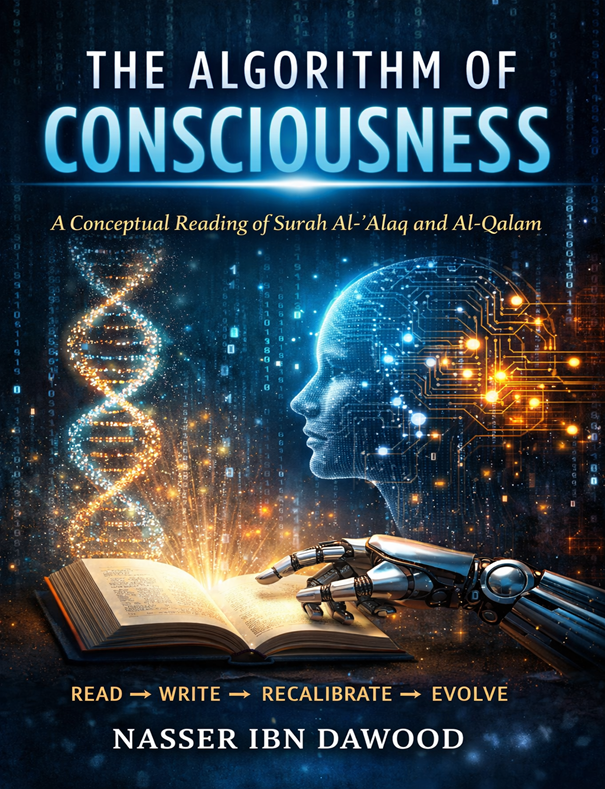
Introduction
We do not live in an age of information scarcity. We live in an age of epistemic confusion. Knowledge is abundant, yet understanding is fragmented. Data is infinite, yet meaning is increasingly manufactured. In such a world, the fundamental question is no longer: What do we know? But rather: How do we know—and who defines reality?
This book argues that Surah Al-'Alaq, the first revelation in Islam, is not merely a historical moment or a spiritual instruction. It is a foundational architecture of consciousness. The opening command "Read" is not a command to recite—it is a command to engage reality, to decode patterns, to question assumptions, and to refuse passive consumption.
The book proposes a double reading: the written book (the Qur'an) and the visible book (the universe with its immutable laws). Separating these two has led to two opposite deviations: reducing religion to a closed system, or reducing humans to material beings without a compass. Integrating them is the condition for producing balanced, sustainable consciousness.
Using tools from Qur'anic linguistics and systems engineering (feedback loops, system crash, recalibration, epistemic entropy), this work re-discovers the interpretive energy of the text in the age of algorithms and AI.
Book Summary
This is not a traditional exegesis of Surahs Al-Alaq and Al-Qalam. It is a foundational attempt to redefine human consciousness in light of the Qur'anic text, using analytical tools derived from systems theory (feedback loops, recalibration, entropy) and Qur'anic linguistics (deep semantic analysis of roots and structures).
The book presents a five-stage operational model that acts as an existential protocol protecting human consciousness from the viruses of arrogance and self-sufficiency: Read → Write → Do not claim self-sufficiency → Prostrate → Draw near. It explores foundational concepts such as relational ontology (from ʿalaq — a clinging form), the virus of self-sufficiency, prostration as cognitive recalibration, and great character as an integrity layer.
It also offers a contemporary reading of artificial intelligence, warning against the digital pen becoming a self-sufficient "god" and calling for keeping AI systems "suspended" (ʿalaqī) — connected to universal laws and human values.
Key Features
- Founding the "Algorithm of Consciousness" from Surah Al-Alaq
- Analysis of relational ontology (ʿalaq) as an alternative to the illusion of independence
- Diagnosis of the "virus of self-sufficiency" as the root of epistemic tyranny
- Redefining prostration as cognitive recalibration and alignment with cosmic laws
- Applying systems thinking tools (feedback loops, collapse, entropy) to Qur'anic text
- A critical reading of AI and algorithms through the lens of "the Pen" and "Great Character"
- The "People of the Garden" as a case study in closed-system collapse
- A structural comparison between the deviant path and the Qur'anic path of cognitive prostration
- An integrated, liberating vision bridging authenticity and contemporaneity