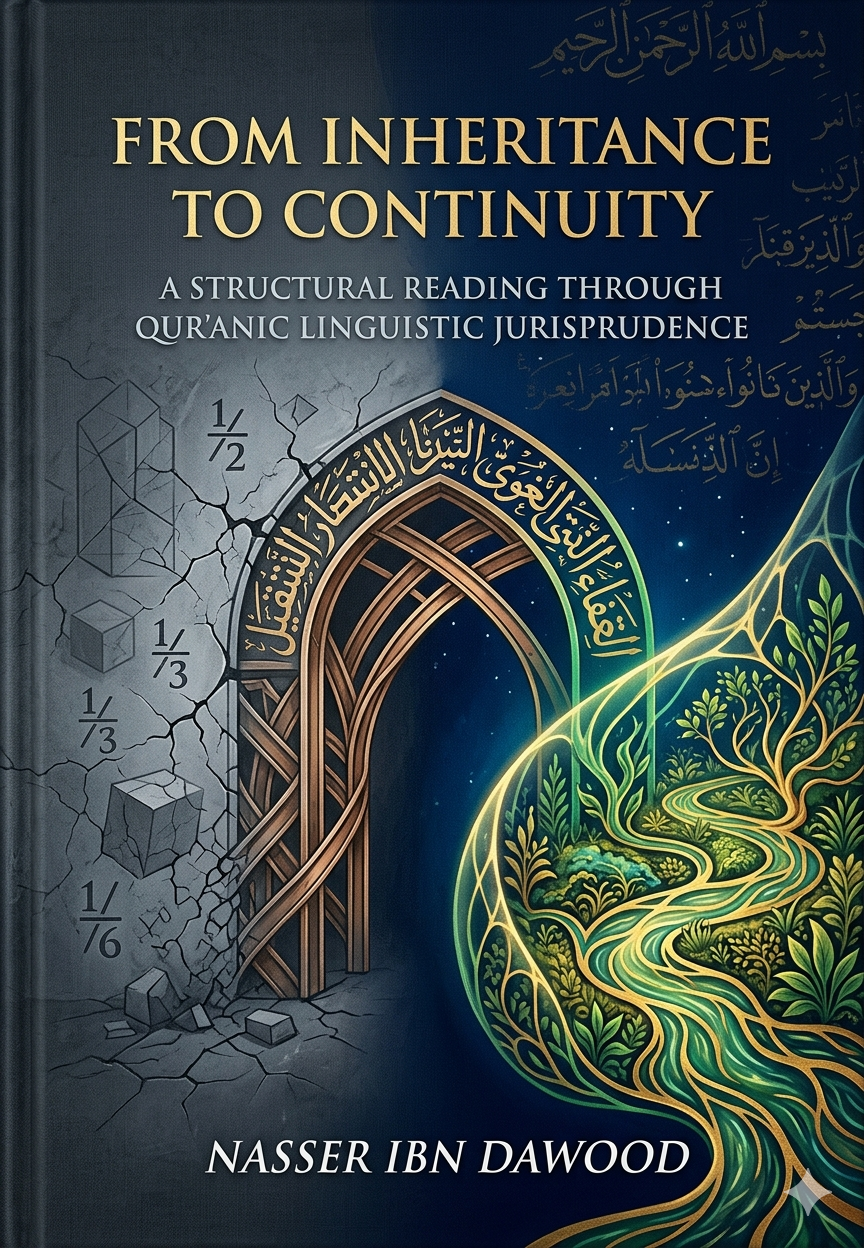
Foreword: Why This Book Matters
For centuries, Islamic inheritance law ( 'ilm al-farā'iḍ ) has been treated as a precise mathematical calculator—a set of rigid fractions to divide a deceased person's material wealth. Yet, despite this "accurate application," we witness family disintegration, bitter disputes, and the marginalization of the weak. This book argues that the problem lies not in the divine text but in our reading tools. The Qur'an does not speak in ordinary "language" (a human, evolving social construct); it speaks in a cosmic "Lisān" — a coded, structural operating system. When we confuse the two, we turn a protocol for continuity into a machine for liquidation.
The central hypothesis: Inheritance in the Qur'an is not a system for dividing estates, but a system for managing continuity, an engineering of impact (material and cognitive) transfer from one generation to the next, ensuring that the human vicegerency project does not stop when its bearer's breath ceases.
Method: "Qur'anic Linguistic Jurisprudence" – distinguishing between "language" (a changing social phenomenon) and "Lisān" (a fixed cosmic system), treating the linguistic root as a code carrying a structural function. With these tools, inheritance ceases to be "wealth division" and becomes "load distribution" and "energy redistribution" within a continuous entity.
Condensed Conceptual Summary
Part I: The Method – Qur'anic Linguistic Jurisprudence
Language vs. Lisān. Large Derivation (ishtiqāq kabīr) and the Nūn of Functional Multiplicity. The Qur'anic nūn describes groups sharing a functional state, regardless of biological sex.
Part II: Redefining Core Concepts
Estate (Taraka): not possessions but the continuous path containing impact. Inheritance (Mīrāth): the container of repeated stability. Luck (Ḥaẓẓ): systemic apportionment, not chance. Male/Female: functional states of firm consciousness vs. receptivity. Men/Women: advanced vs. delayed functional categories. Guardianship (Qiwāmah): a support system, not privilege. Parent/Child: intellectual generation. Kalālah: horizontal recovery protocol when vertical line breaks.
Part III: Procedural Laws
"For the male the equivalent of the share of two females" – load distribution based on responsibility. The Sixth (Sudus) and Eighth (Thumn) as safety valves. Will (Waṣiyyah): the sovereign manual, not an exception. Boundaries (Ḥudūd): protective membranes preventing collapse.
Part IV: Strategic Outcomes
From fiqh of distribution to fiqh of continuity. Three pillars: Will (sovereignty), Inheritance (social safety net), Boundaries (protection). Practical implementation: individual, legal, judicial, cultural levels.
Conclusion: The Declaration of Conscious Independence
"A human being is responsible for their inheritance through consciousness... whoever is conscious, plans; whoever plans, continues; whoever continues, their impact never dies."
Key Features
- Dismantling the "calculator illusion" in understanding inheritance
- Founding "Qur'anic Linguistic Jurisprudence" as a structural reading tool
- Redefinition of: Taraka, Mīrāth, Nisā', Rijāl, Ḥaẓẓ, Wālid, Walad, Ikhwa, Kalālah
- Will (Waṣiyyah) as sovereign origin, not exception
- "For the male the equivalent of two females" – operational budget distribution by responsibility, not gender preference
- Allah's boundaries as protective membranes against societal collapse
- Practical application models: structural wills, evaluation matrices, real scenarios
- Critique of traditional fiqh: 'awl, hijāb, "no bequest to an heir"
- The transition from fiqh of distribution to fiqh of continuity