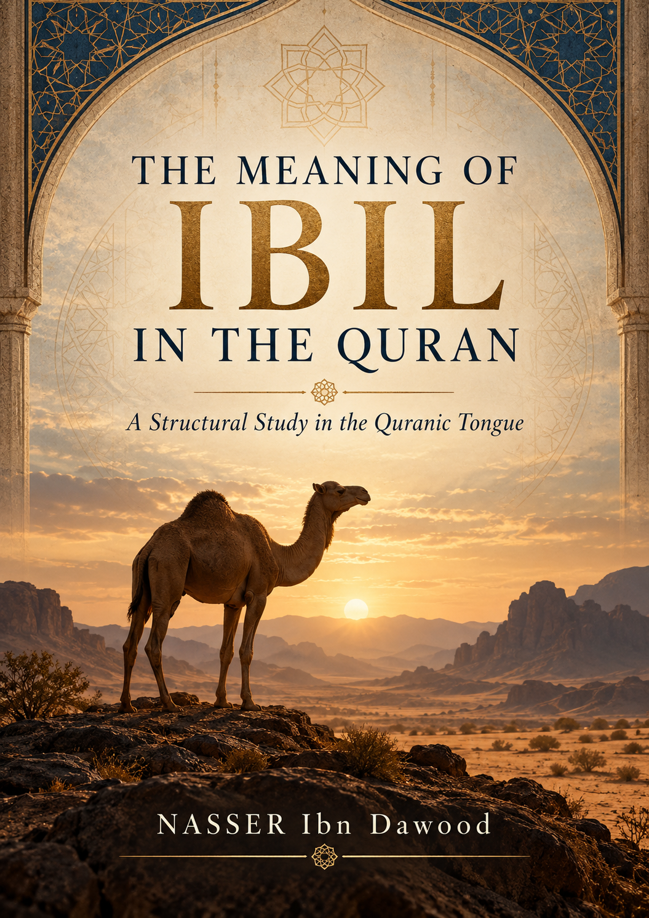
- Author
- Nasser Ibn Dawood
- Book number
- 108 / 139
- Language
- English
- Pages
- ≈ 17
- Words
- 4,215
- Reading time
- ≈ 0.4 h
- Category
- Quranic Studies
- Licence
- CC BY-SA 4.0
Page count is estimated from the text size (4,215 words); the library index records no print page count for this title.
Text extracted from the author-supplied Word edition; consult the original source.
Opening of the book
This volume is a condensed conceptual adaptation of the author’s Arabic study. It preserves the central argument, methodological controls, major tests, and final claim-statuses while omitting most of the exhaustive laboratory records, repeated audit tables, extended lexical debates, and internal project documentation of the Arabic edition.
The Qur’anic term ibil is retained in analytical passages because the book distinguishes the Qur’anic word from the wider zoological category and from other Qur’anic camel-related terms such as nāqah, baʿīr, and jamal. In ordinary explanatory prose, “camel” or “camels” is used when no lexical ambiguity arises.
Qur’anic references are given by sūrah name and verse number. English renderings of verses in this edition are conceptual translations prepared for readability rather than quotations from a published English translation.
Topics
- Ibil
- Meaning of Ibil
- Ibil in the Quran
Excerpt
Earlier work connects the sky with elevation, receiving, descent, provision, and an upper horizon. In al-Ghāshiyah, however, the local verb is “raised.” The immediate evidence therefore supports an elevated created structure and an upper field of contemplation. Broader ideas such as reception, descent, or cognitive ascent require bridges from other contexts and cannot simply be imported.
By Nasser Ibn Dawood — The Meaning of Ibil in the Qur’anDownload the book
Formats: TXT · DOCX · PDF
Read the PDF on this website
Preparing the reader…