- Author
- Nasser Ibn Dawood
- Book number
- 119 / 139
- Language
- English
- Pages
- ≈ 17
- Words
- 4,340
- Reading time
- ≈ 0.4 h
- Category
- Quranic Studies
- Licence
- CC BY-SA 4.0
Page count is estimated from the text size (4,340 words); the library index records no print page count for this title.
This is a condensed conceptual English adaptation, not a word-for-word translation. The Arabic edition remains the primary source for detailed analysis and references.
Opening of the book
In this volume, the main retained terms are ʿilm, rizq, istikhlāf, amānah, mīzān, and ʿumrān. The terms named above express the wider translation policy; they are not all subjects of Part Two. No formal status is assigned to a proposition merely by translating it. Interpretive proposals remain proposals, and illustrative applications remain hypothetical.
Part One explored knowledge, intellectual awareness, and the relationship between reading the written revelation and studying the world. Part Two asks how understanding becomes a shared capacity to serve people and cultivate the earth. Books, databases, and qualifications may accumulate while a society still struggles to recognize its needs or improve its services. The difficulty can lie in the connections between questions and evidence, specialists and communities, or capability and purpose.
We call the structure that maintains these connections a knowledge network. It links sources, researchers, teachers, institutions, tools, and applications. It also returns the consequences of application to researchers so that they can revise what they know. Its strength depends on accurate attribution, freedom to question, fair participation, and the possibility of correction.
Main axes 18
- Part Two
- Introduction
- Part One
- Chapter 1 How Knowledge Takes Shape
- Chapter 2 From the Pen to the Algorithm
- Chapter 3 Epistemic Provision and Better Research
- Chapter 4 Knowledge Forms the Responsible Human Being
- Chapter 5 Wisdom and the Balance of Capability
- Chapter 6 Regularities Resources and Sound Civilization
- Part Three
- Chapter 7 The Architecture of Shared Knowledge
- Chapter 8 Artificial Intelligence Within the Network
- Chapter 9 Turning Knowledge Into Practical Service
- Part Four
- Chapter 10 Ethics Throughout Inquiry
- Chapter 11 Governing Knowledge and Correcting Its Course
- Chapter 12 A Practical Programme for Stewardship
- Conclusion
Headings extracted from the structure of the book's text file.
Excerpt
The passage about teaching Adam the names appears within the Qurʾanic account of a khalīfah on earth. We examine the connection between the ability to understand and identify things, the capacity to communicate, and responsibility in action. This is a point of departure for studying human capability; it is not a ready-made catalogue of modern disciplines. [Q4]
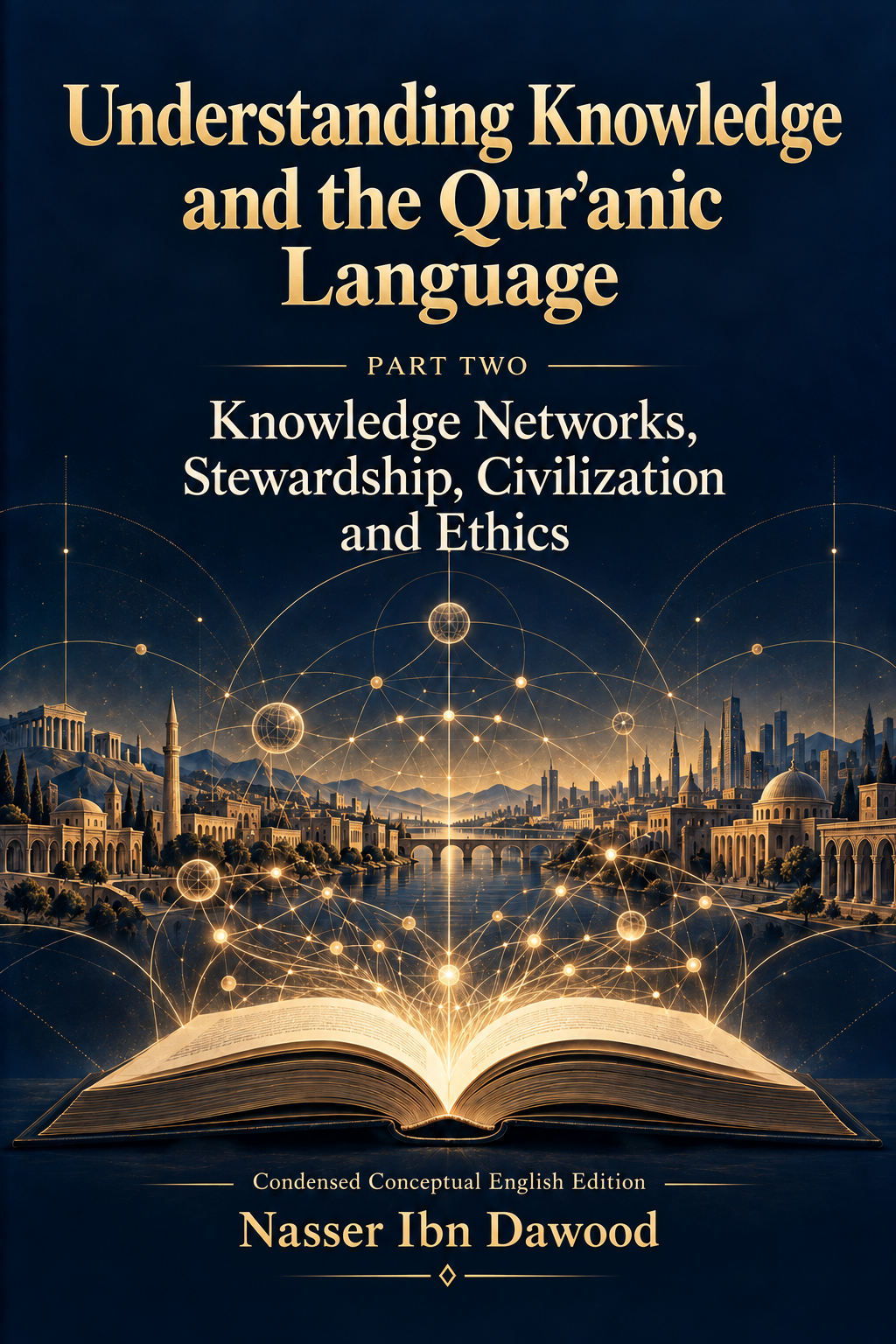
By Nasser Ibn Dawood — Understanding Knowledge and the Qurʾanic Language — Part Two: Knowledge Networks, Stewardship, Civilization and EthicsTopics
- Knowledge networks
- Qurʾanic language
- Stewardship
- Civilization
- Ethics
- Epistemic provision
- Artificial intelligence
- Knowledge governance
Download the book
Formats: TXT · DOCX · PDF
قراءة PDF داخل الموقع / Read the PDF on this website
جارٍ تجهيز القارئ… / Preparing the reader…