- Author
- Nasser Ibn Dawood
- Book number
- 79 / 139
- Language
- English
- Pages
- ≈ 23
- Words
- 5,854
- Reading time
- ≈ 0.5 h
- Category
- Quranic Studies
- Licence
- CC BY-SA 4.0
Page count is estimated from the text size (5,854 words); the library index records no print page count for this title.
Text extracted from the author-supplied Word edition; consult the original source.
Opening of the book
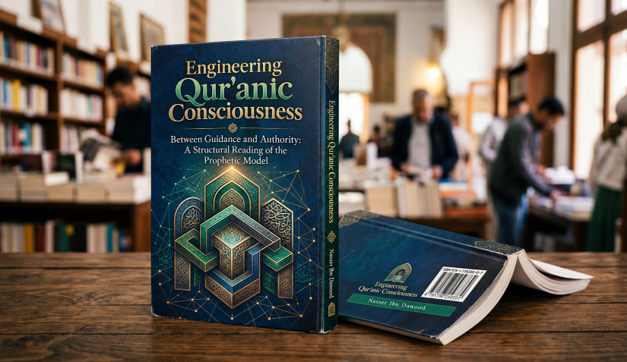
This book begins from a diagnosis. The author argues that a major part of the modern Muslim intellectual crisis does not arise from a shortage of sacred text, nor from the absence of religious vocabulary, but from a structural problem in the way the relationship between the Qur’an, inherited interpretation, political power, and human responsibility has been organized over time. The question is therefore not simply, “What does Islam say about the state?” It is more basic: “How does the Qur’an organize the relationship between divine guidance and human agency?”
The central thesis is that two domains must be distinguished without being torn apart. The first is the domain of divine guidance: revelation, moral orientation, ultimate meaning, accountability before God, and the formation of conscience. The second is the domain of human administration: institutions, public policy, lawmaking procedures, economic management, social contracts, and political arrangements. The first draws its authority from revelation; the second remains a human field of judgment, consultation, experience, revision, and accountability.
In the author’s reading, many historical confusions began when these two domains were fused. Human institutions acquired sacred status, political obedience became religious obedience, inherited interpretations were treated as if they were revelation itself, and the believer was gradually repositioned from a responsible moral agent into a dependent subject. The book therefore attempts a reverse engineering of this process: it starts with key Qur’anic terms, traces the semantic shifts that affected them, and asks what happens when they are returned to the internal architecture of the Qur’anic discourse.
Topics
- Quranic consciousness
- Guidance
- Authority
- Muhammadan model
Excerpt
Shūrā is treated as more than a ceremonial consultation conducted after a ruler has already decided. Its deeper purpose is to convert dispersed human knowledge into better public judgment. Consultation requires access to information, the possibility of disagreement, the ability to revise decisions, and institutional safeguards against domination.
By Nasser Ibn Dawood — Engineering Qur’anic Consciousness: Between Guidance and AuthorityDownload the book
Formats: TXT · DOCX · PDF
Read the PDF on this website
Preparing the reader…