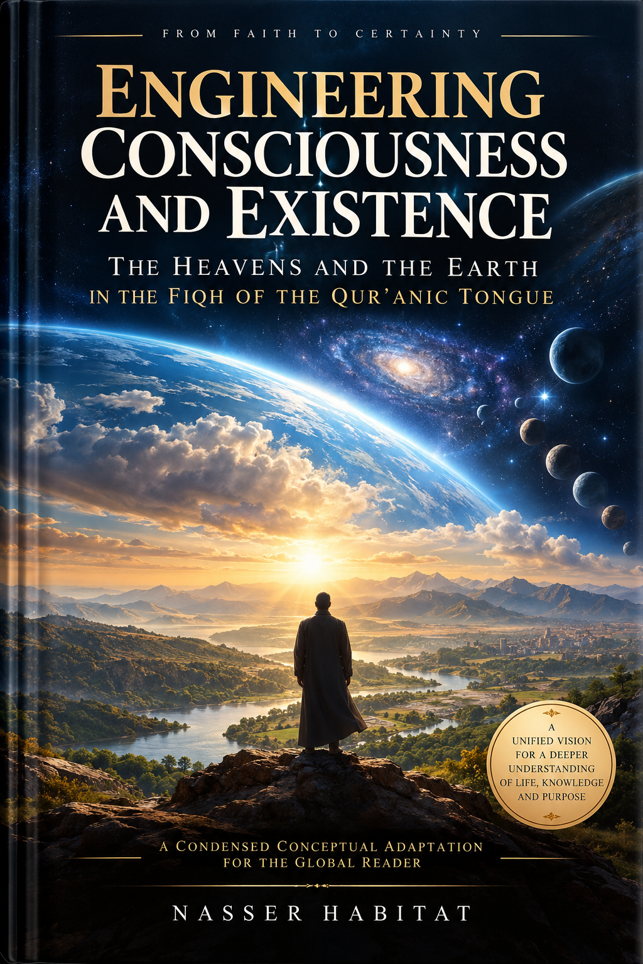
- Author
- Nasser Ibn Dawood
- Book number
- 75 / 139
- Language
- English
- Pages
- ≈ 23
- Words
- 5,735
- Reading time
- ≈ 0.5 h
- Category
- Quranic Studies
- Licence
- CC BY-SA 4.0
Page count is estimated from the text size (5,735 words); the library index records no print page count for this title.
Text extracted from the author-supplied Word edition; consult the original source.
Opening of the book
A further clarification is essential for the present edition. The Arabic work uses the expression Fiqh al-Lisan al-Qur’ani, rendered here as “Fiqh of the Qur’anic Tongue.” In this context, fiqh is not restricted to legal jurisprudence. It refers to disciplined understanding: tracing Qur’anic usage, attending to roots, contexts, structural relations, contrasts, and recurring patterns, then testing whether a proposed meaning can remain coherent across the text. The word “tongue” is retained because the author treats Qur’anic language as an internally structured system rather than as a loose collection of interchangeable synonyms.
This book begins with a simple but far-reaching question: when the Qur’an speaks of heaven and earth, stars and water, rising and falling, building and spreading, is it only describing the physical world outside us? Or does the same language also train the human being to read an inner world of perception, conviction, desire, action, and moral consequence?
The argument developed here is that the Qur’anic cosmos can be read on two coordinated registers. The first is the world of the horizons: the visible created order, with earth, heaven, water, stars, mountains, motion, stability, growth, ruin, and renewal. The second is the world of the selves: the inward field in which knowledge is received, beliefs become settled, intentions are formed, choices are made, and human beings rise toward clarity or fall into confusion. These two registers are not treated as rivals. They are mirrors. The external world is not dissolved into psychology, and the inner world is not reduced to matter. Rather, the reader is invited to observe structural correspondences between them.
Main axes 9
- Introduction — The Two Worlds and the Journey to Certainty
- Part One — Earth, Heaven, and the Human Meeting Point
- Part Two — The Layered Structure of Existence
- Part Three — The Inner Orbit: Heart, Paradise, and Constriction
- Part Four — Signs of Guidance: Stars, Lamps, and Layers
- Part Five — Worship as a Laboratory of Integration
- Part Six — Corruption, Flood, Earthquake, and the Laws of Separation
- Part Seven — Witness, Awakening, and the Path of Certainty
- Conclusion — From Horizons to Selves
Headings extracted from the structure of the book's text file.
Excerpt
The heart is the central organ of this meeting. It receives, turns, inclines, hardens, softens, remembers, and forgets. The book uses this Qur’anic moral vocabulary to describe consciousness as something dynamic rather than static. A person is not defined only by what he or she knows, but by what the heart does with what is known.
By Nasser Ibn Dawood — Engineering Consciousness and ExistenceTopics
- Engineering consciousness
- Existence
- Heaven and earth
- Quranic linguistic jurisprudence
Download the book
Formats: TXT · DOCX · PDF
Read the PDF on this website
Preparing the reader…