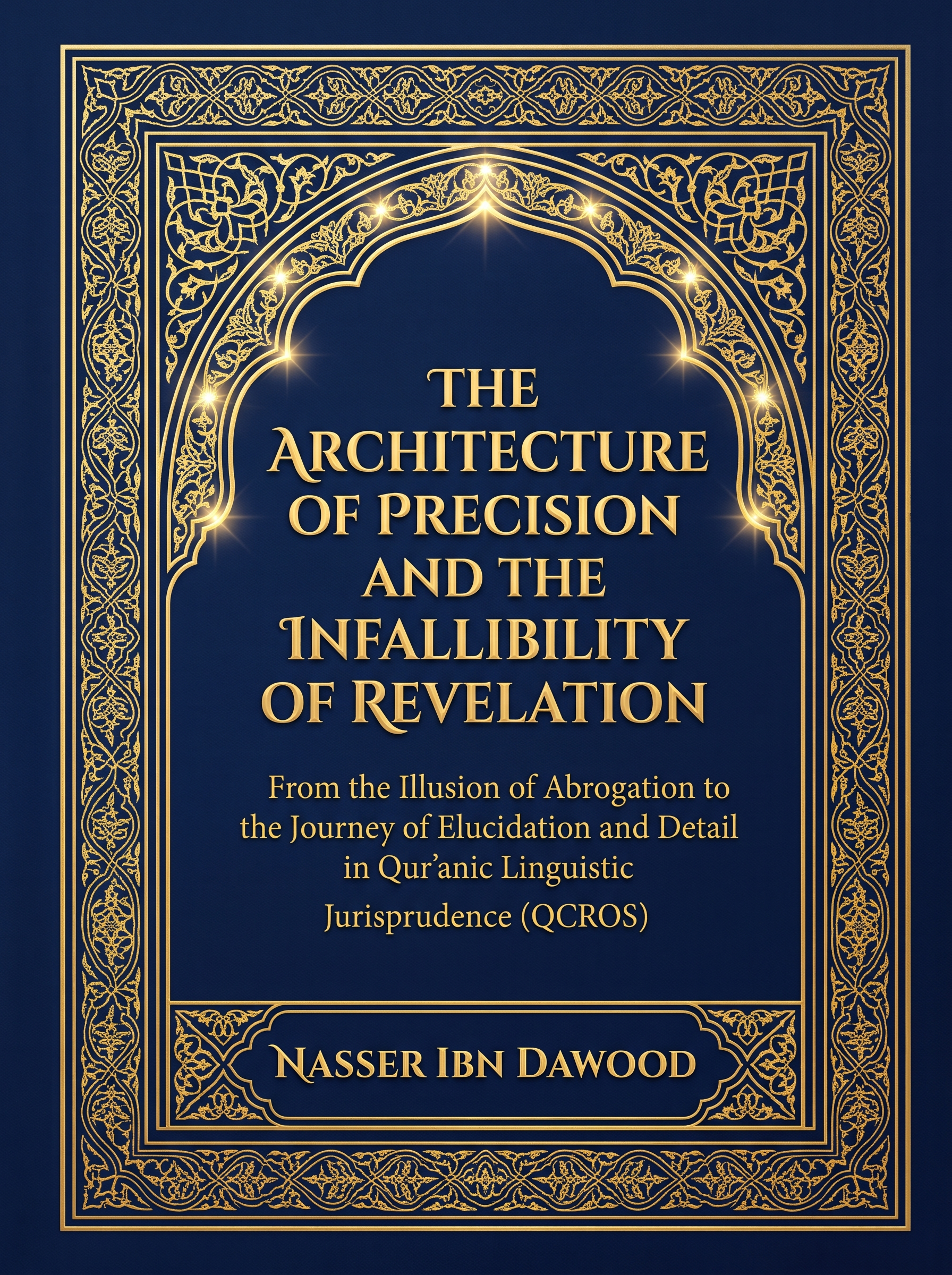
- Author
- Nasser Ibn Dawood
- Book number
- 143 / 145
- Language
- English
- Pages
- ≈ 32
- Words
- 8,053
- Reading time
- ≈ 0.7 h
- Category
- Quranic Studies
- Licence
- CC BY-SA 4.0
Page count is estimated from the text size (8,053 words).
Condensed conceptual adaptation; the Arabic work remains the primary source. Search text extracted from Word; consult the original for tables, structural diagrams, and formatting.
Opening of the book
The Digital Library: As of early 2026, the collection hosts 236 volumes (118 in Arabic and 118 in English), fully optimized for AI-assisted research and digital archiving.
This English edition is a condensed conceptual adaptation. It is not a word-for-word translation, but rather an "extraction of essence." It presents the core philosophical framework in accessible English, omitting the exhaustive linguistic debates and classical references found in the original Arabic text.
For the academic researcher: The original Arabic version remains the primary source for comprehensive linguistic analysis, detailed exegesis (Tafsir), and the complete bibliography.
Main axes 18
- I. The Global Knowledge Manifesto
- II. Translator’s Note: The Bridge of Meaning
- III. Executive Summary & Reader’s Guide
- IV. Introduction: The Compass of Epistemic Humility (al-Ḥayāʾ al-Maʿrifī)
- V. Part One: Deconstructing the Traditional Foundation & The "Three Pillar Verses"
- Chapter 1: The Qur’anic Lexicon of the Root (N-S-Kh) and Q 2:106
- Chapter 2: Liberating Q 13:38–39, Q 16:101, and Q 87:6–7
- Chapter 3: The Supremacy of the Qur’an, the Fall of "Substitution Reports," and the Internal Collapse of Classical Uṣūl
- Chapter 4: Exclusive Legislative Sovereignty & The Theological Danger of "Legislative Associating"
- VI. Part Two: The Applied Field — Deconstructing the "Five Consensus Verses" and al-Suyūṭī’s 22-Verse Canon
- Chapter 1: The Architecture of Inner Accountability & Moral Capacity (Q 2:284–286) [N]
- Chapter 2: The Morphological Engineering of Sexual Offenses (Q 4:15–16 & Q 24:2) [N]
- Chapter 3: Prophetic Matrimonial Covenants — Past Confirmation vs. Future Restriction (Q 33:50 & 52) [N]
- Chapter 4: Widow’s Mandatory Waiting Period (ʿIddah) vs. Optional Housing Bequest (Waṣiyyat al-Matāʿ) (Q 2:234 & 240) [N / S/H]
- Chapter 5: Defensive Combat Ratios and the Explicit Operative Cause (Manāṭ) (Q 8:65–66) [N]
- Chapter 6: The Crime of "Abrogating the Qur’an by Solitary Reports" — Parental Bequests (Waṣiyyah) and Religious Freedom [N]
- Chapter 7: Comprehensive Audit of al-Suyūṭī’s Full 22-Verse List [N]
- VII. Part Three: Epistemic Governance — Reverse Stress Tests (QCROS) & Structural Matrices
Headings taken from the book’s own outline.
Excerpt
1. Q 33:50 Governs the Existing Past: When the four-wife limit was legislated for believers in general, men with more than four wives were required to divorce the excess. Because the Prophet’s ﷺ existing wives—expressed in the past tense "to whom you have given (ātayta) their dowries"—were declared Mothers of the Believers who could never marry anyone else after him (Q 33:53), divorcing any of them would have condemned her to lifelong deprivation. Thus, Divine mercy permitted him to retain his current wives already in his marital bond.
By Nasser Ibn Dawood — The Architecture of Precision and the Infallibility of Revelation: From the Illusion of Abrogation (Naskh) to the Journey of Elucidation and Detail in Qur’anic Linguistic JurisprudenceTopics
- Architecture of Precision
- Infallibility of Revelation
- Abrogation (Naskh)
- Ihkam and Tafsil
- Epistemic Humility
- Topical Arrangement
- Operative Legal Cause (Manat)
- Quranic linguistic jurisprudence
- Reverse Stress Testing
- QCROS
Download the book
Formats: TXT · DOCX · PDF
قراءة PDF داخل الموقع / Read the PDF on this website
جارٍ تجهيز القارئ… / Preparing the reader…