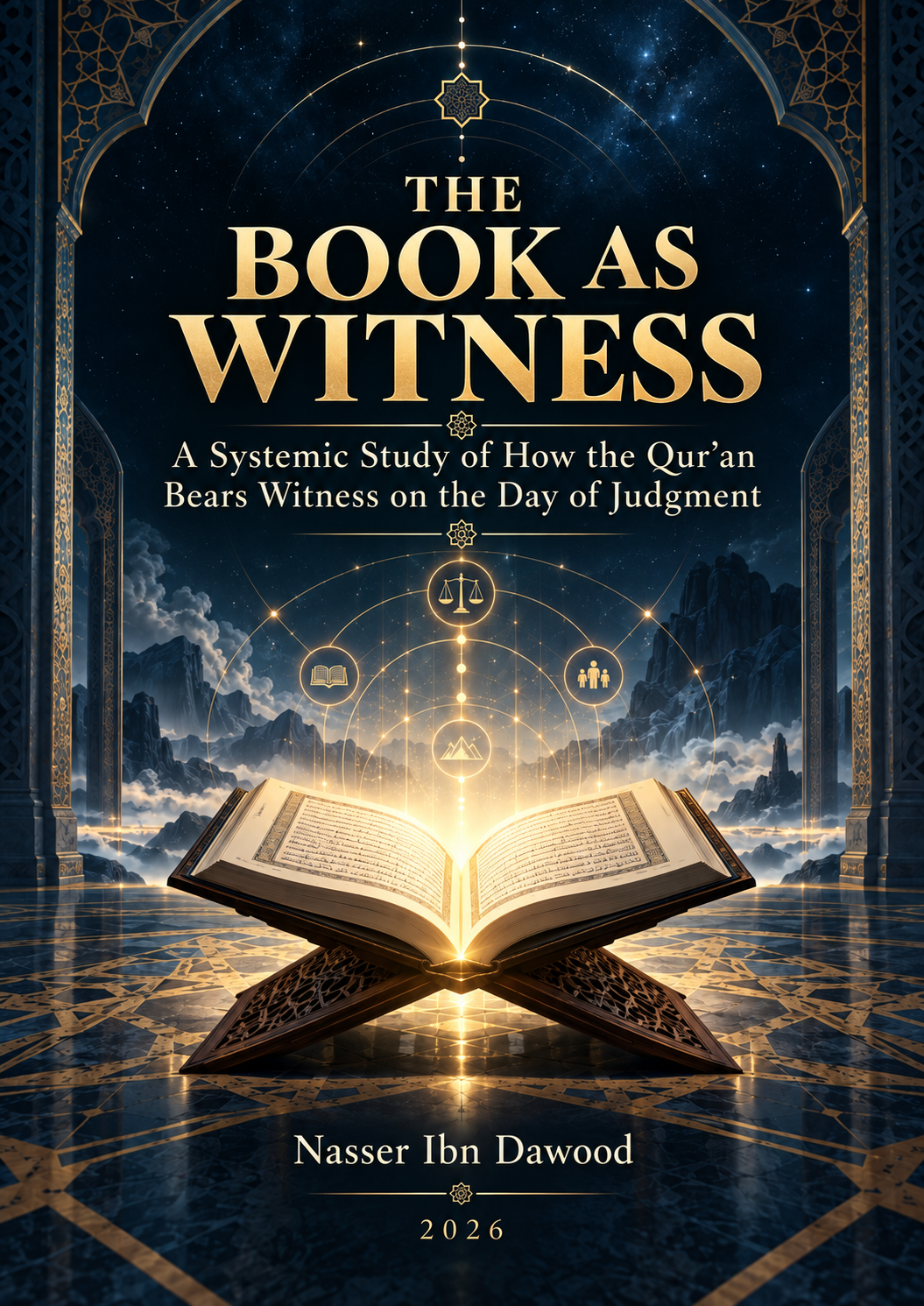
- Author
- Nasser Ibn Dawood
- Book number
- 117 / 139
- Language
- English
- Pages
- ≈ 24
- Words
- 6,010
- Reading time
- ≈ 0.6 h
- Category
- Quranic Studies
- Licence
- CC BY-SA 4.0
Page count is estimated from the text size (6,010 words); the library index records no print page count for this title.
Opening of the book
This book asks a question that its title deliberately does not answer in advance: how does revelation appear within the Qur’anic network of accountability and evidence, especially in eschatological scenes? Does the text permit us to say that the Qur’an, or al-kitāb, functions as a formal judicial witness on the Day of Judgment? Or does the Qur’an present a more complex architecture in which revelation, messengers, witnesses, deeds-records, bodily testimony, and divine judgment remain distinct even when they appear in the same scene?
The phrase “The Book as Witness” is therefore an analytical title, not a claim that the Qur’an literally names itself “the witness,” nor a claim that the revealed Book is identical with the record of deeds. The book begins by establishing an epistemic guard: shared wording does not prove shared referent, co-occurrence does not prove causation, a local relation does not automatically become a root-wide law, and a model does not become a textual fact merely because it explains the data elegantly.
The study then moves through eight chapters. It first establishes the QCROS research path and the Mathānī method as a discovery tool rather than an independent proof. It distinguishes among kitāb, Qurʾān, dhikr, and furqān without forcing either absolute synonymy or absolute separation. It then examines the architecture of waḥy, messenger authority, prophetic clarification, and the question of whether any of these establish a second independent preserved legislative corpus. From there, it turns to preservation, continuity, confirmation, hegemony, religious unity, plurality of shirʿah, the difference between ikhtilāf and tafarruq, the eschatological network of evidence, and finally the analytical fields of functional displacement, authority displacement, laghw, ṭāghūt, and legislation without divine authorization.
Main axes 12
- Chapter One — Epistemological Foundation
- Chapter Two — Kitāb, Qurʾān, Dhikr, and Furqān
- Chapter Three — The Architecture of Revelation
- Chapter Four — The Continuing Corpus
- Chapter Five — “What Was Revealed Before You”
- Chapter Six — Difference, Dīn, Shirʿah, Sharīʿah, and Minhāj
- Chapter Seven — The Architecture of Witnessing
- Chapter Eight — The Architecture of Authority Displacement
- Appendix I — Major Theses and Their Scientific Status
- Appendix II — Open Research Agenda
- Appendix III — Reader’s Claim Card
- Appendix IV — Conceptual Maps
Headings extracted from the structure of the book's text file.
Excerpt
Qur’an 11:118 describes human beings as continuing to differ. Qur’an 3:105 warns against people who divided and differed after clear signs came to them. These two uses prevent opposite reductions: not every difference is divinely approved, and not every difference is condemned division. IKHTILĀF ≠ TAFARRUQ = CLOSED as a structural distinction. The moral value of a particular difference remains contextual.
By Nasser Ibn Dawood — The Book as WitnessTopics
- Book
- Witness
- Revelation
- Accountability
- Evidence
- QCROS
Download the book
Formats: TXT · DOCX · PDF
قراءة PDF داخل الموقع / Read the PDF on this website
جارٍ تجهيز القارئ… / Preparing the reader…