- Author
- Nasser Ibn Dawood
- Book number
- 144 / 145
- Language
- English
- Pages
- ≈ 28
- Words
- 7,125
- Reading time
- ≈ 0.6 h
- Category
- Quranic Studies
- Licence
- CC BY-SA 4.0
Page count is estimated from the text size (7,125 words).
Condensed conceptual adaptation; the Arabic work remains the primary source. Search text extracted from Word; consult the original for tables, diagrams, and formatting.
Opening of the book
The Digital Library: As of early 2026, the collection hosts 236 volumes (118 in Arabic and 118 in English), fully optimized for AI-assisted research and digital archiving.
This English edition is a condensed conceptual adaptation. It is not a word-for-word translation, but an extraction of the book’s central argument. It presents the philosophical and methodological framework in accessible English while abridging extended linguistic discussions, repeated formulations, and overlapping diagrams.
For the academic researcher, the original Arabic version remains the primary source for detailed linguistic analysis, the full interpretive argument, and its references. This adaptation follows the Arabic reader’s edition that includes the author’s acknowledgement of the video series that prompted the book.
Main axes 12
- I. The Global Knowledge Manifesto
- II. Translator’s Note
- Part One — Compositional architecture
- Part Two — The ten-surah thesis
- Part Three — Letter pairs and semantic movement
- Part Four — The operational cycle of reception
- Part Five — Adjacent concepts and interpretive authority
- Part One
- Part Two
- Part Three
- Part Four
- Part Five
Headings taken from the book’s own outline.
Excerpt
The series discussed in the Arabic book identifies ten surahs: al-Aʿrāf, al-Raʿd, Maryam, Ṭā Hā, al-Naml, Yā Sīn, Ṣād, al-Shūrā, Qāf, and al-Qalam. As represented in the manuscript, the thesis links their opening letters and patterns of address to a claim that these ten alone constitute “the Qur’an,” while other portions of the muṣḥaf belong to a different category.
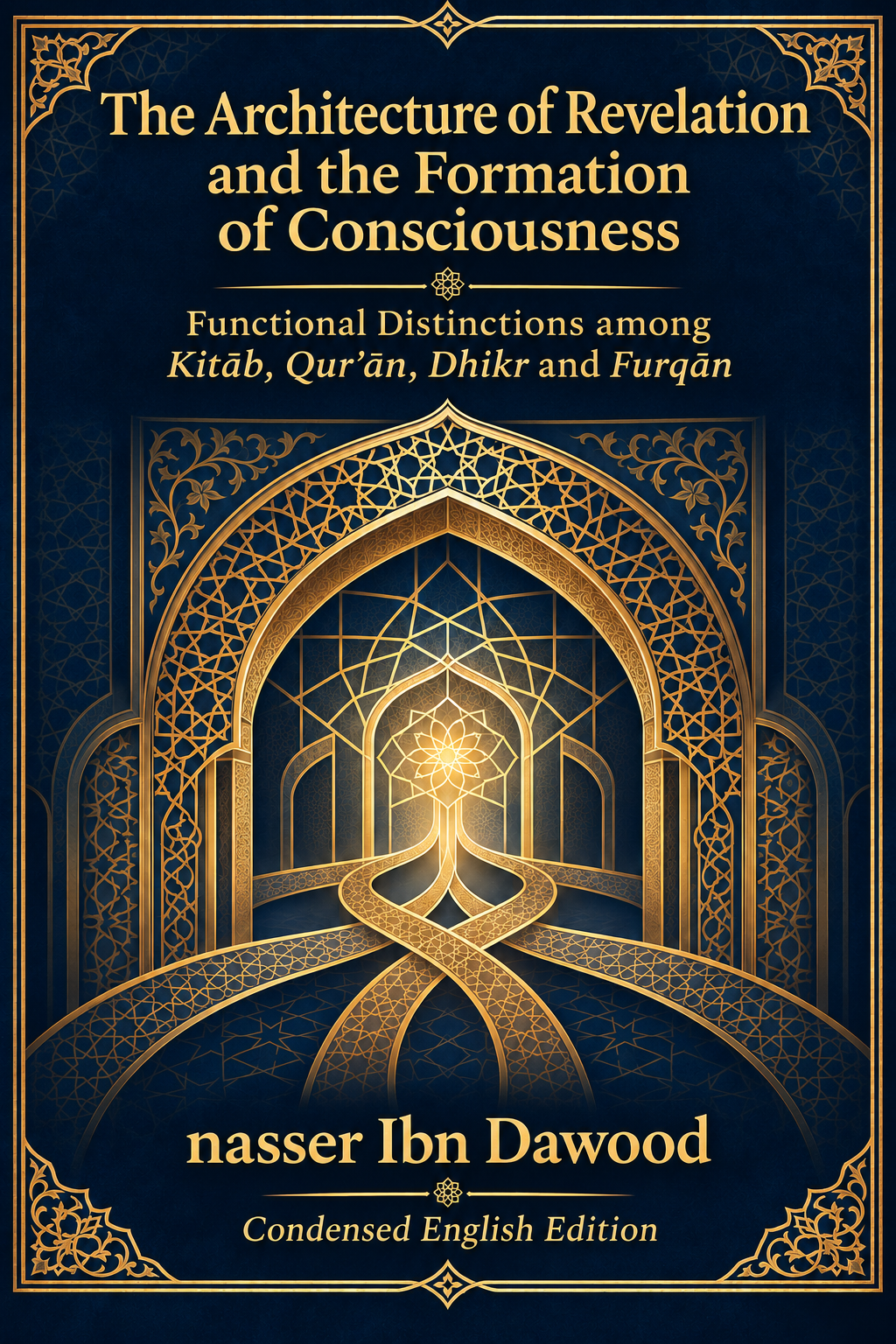
By Nasser Ibn Dawood — The Architecture of Revelation and the Formation of Consciousness: Functional Distinctions among Kitāb, Qurʾān, Dhikr, and FurqānTopics
- Architecture of Revelation
- Formation of Consciousness
- Compositional Inimitability
- Kitab Quran Dhikr Furqan
- Seven Mathani
- Surat al-Shura
- Quranic linguistic jurisprudence
- MATHANI-NET
- QCROS
Download the book
Formats: TXT · DOCX · PDF
قراءة PDF داخل الموقع / Read the PDF on this website
جارٍ تجهيز القارئ… / Preparing the reader…